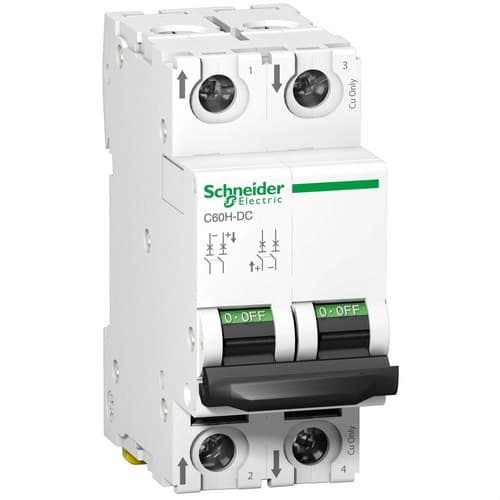
Information about C60H Circuit Breaker 500V 2P 6A Curve C
The Schneider Electric Acti9 C60H-DC A9N61526 thermal-magnetic circuit breaker is a modular automatic switch specifically designed for the protection of DC circuits. It features 2 protected poles, a rated current of 6 A, C tripping curve, and a rated operational voltage of up to 500 V DC. Its thermal-magnetic protection acts against overloads and short circuits, with an ultimate breaking capacity Icu of 6 kA at 500 V DC in accordance with IEC/EN 60947-2.
The A9N61526 reference belongs to Schneider Electric’s Acti9 C60H-DC family, developed for DC networks that require high breaking capacity and a device suitable for isolation. It can be installed on a 35 mm DIN rail and supports the addition of auxiliaries, remote monitoring systems, and certain compatible Acti9 accessories.
DC-specific thermal-magnetic circuit breaker
Unlike a conventional circuit breaker intended mainly for AC networks, the C60H-DC A9N61526 is expressly designed to operate in DC networks.
This feature is especially important because interrupting direct current places greater demands on the breaker contacts, since there is no natural current zero crossing as occurs periodically in AC.
For this reason, DC applications must use breakers expressly certified for the voltage, current, and pole configuration of the installation.
2 poles and 2 protected poles
The Schneider Electric A9N61526 has a 2-pole configuration and both poles are protected by the thermal-magnetic tripping system.
- Total number of poles: 2P.
- Number of protected poles: 2.
- Switched neutral: not applicable as a 1P+N configuration.
Using both poles together allows the DC voltages specified by Schneider Electric to be achieved, always respecting the connection diagrams and polarity established for the C60H-DC range.
Rated current of 6 A
The breaker’s rated current is 6 A at a reference temperature of 25 °C.
This rating is intended for low-current DC circuits whose conductors and loads have been correctly sized.
Selection should take into account:
- Circuit operating current.
- Conductor cross-section and thermal capacity.
- Ambient temperature.
- Line length.
- Expected short-circuit current.
- Maximum DC operating voltage.
- Characteristics of the connected load.
Thermal-magnetic protection
The Acti9 C60H-DC uses a thermal-magnetic trip unit, combining two complementary protection principles:
- Thermal trip: protects against sustained overloads that can cause excessive heating of cables and equipment.
- Magnetic trip: acts quickly against high currents caused by a short circuit.
In this way, the A9N61526 protects the circuit against both prolonged overcurrents and high-magnitude faults.
C curve adapted to DC
The reference includes a C tripping curve. For the C60H-DC family, Schneider Electric defines the magnetic tripping characteristic of curve C at approximately 7 to 10 times the rated current, under the reference conditions of IEC/EN 60947-2.
In a 6 A device, this characteristic allows certain transient current peaks to be tolerated without immediate magnetic tripping, while still maintaining a fast response to short circuits.
The curve of a DC device should not be automatically equated with the characteristics of a C curve in a conventional AC circuit breaker.
Operational voltage up to 500 V DC
One of the main features of the A9N61526 is its rated operational voltage Ue of 500 V DC.
This value is achieved by using the two poles of the breaker according to the connection configuration indicated by Schneider Electric.
The maximum voltage of a DC installation must be carefully verified, especially in systems where voltage may vary depending on state of charge, environmental conditions, or generator operation.
Breaking capacity of 6 kA at 500 V DC
The ultimate breaking capacity Icu depends on the operating voltage.
Schneider Electric specifies in accordance with IEC/EN 60947-2:
- 220 V DC: Icu of 20 kA.
- 250 V DC: Icu of 20 kA.
- 440 V DC: Icu of 10 kA.
- 500 V DC: Icu of 6 kA.
Therefore, the 6 kA value commonly shown in the commercial title corresponds specifically to the breaking capacity at the maximum rated voltage of 500 V DC.
Service breaking capacity Ics
In addition to Icu, Schneider Electric specifies the service breaking capacity Ics, equivalent to 75% of Icu at the main voltages indicated.
- 220 V DC: Ics of 15 kA.
- 250 V DC: Ics of 15 kA.
- 440 V DC: Ics of 7.5 kA.
- 500 V DC: Ics of 4.5 kA.
The selected breaking capacity must be suitable for the maximum short-circuit current expected at the point where the circuit breaker will be installed.
IEC/EN 60947-2 standard
The Schneider Electric C60H-DC A9N61526 is specified in accordance with:
- IEC 60947-2.
- EN 60947-2.
This standard governs the characteristics and performance of circuit breakers used in low-voltage industrial and professional installations.
Suitable for isolation
Schneider Electric declares the A9N61526 suitable for isolation in accordance with IEC/EN 60947-2.
This allows it to be used, within the conditions established by the manufacturer, to electrically isolate part of the circuit during maintenance and servicing operations.
Insulation voltage and impulse withstand
The main dielectric characteristics of the device include:
- Rated insulation voltage Ui: 500 V DC.
- Impulse withstand voltage Uimp: 6 kV.
- Overvoltage category: IV.
- Pollution degree: 3.
These features allow the device to be integrated into professional DC distribution panels within its rated conditions.
Fast contact closing
The Acti9 C60H-DC incorporates a fast-closing mechanism independent of the speed at which the user operates the handle.
This technology helps ensure consistent contact operation and contributes to reducing wear during closing.
Contact position indicator
The device includes local ON/OFF indication that allows the breaker status to be visually identified.
This signaling facilitates inspection and maintenance operations in panels with multiple protective devices.
Prepared for padlock locking
The A9N61526 is prepared to be locked in the O position using the appropriate locking accessory.
This option can be integrated into lockout and maintenance procedures designed to prevent accidental reconnection of the circuit.
Mounting on 35 mm DIN rail
The breaker is designed for fixed mounting by clip onto a 35 mm symmetrical DIN rail.
Its width corresponds to:
- 4 x 9 mm pitch.
- 2 standard 18 mm modules.
- Approximate width: 36 mm.
This compact format makes it easy to integrate alongside other Acti9 modular devices.
Compatible with busbars and combs
Schneider Electric allows the use of distribution systems via compatible comb busbars or busbars connected from the top or bottom.
This makes it easier to create compact panels and reduces individual wiring when several compatible devices are installed.
Compatible with Acti9 auxiliaries
The C60H-DC family supports different accessories that expand the circuit breaker’s functions.
Depending on the configuration, it can be complemented with:
- Auxiliary contacts.
- Trip signaling contacts.
- Auxiliary releases.
- Remote monitoring devices.
- Locking accessories.
- Comb distribution elements.
- Compatible Vigi residual current devices when the configuration allows it.
The exact reference for each accessory should be verified using Schneider Electric compatibility tables.
Conductor connection
The device terminals allow conductors of different cross-sections to be connected.
- Rigid conductor: 1 to 25 mm².
- Flexible conductor: 1 to 16 mm².
- Tightening torque: approximately 2.5 Nm.
Connections must be made respecting the polarity, cross-section, and tightening torque indicated by the manufacturer.
Mechanical durability
Schneider Electric specifies a mechanical durability of up to 20,000 cycles.
Electrical durability depends on the operating conditions, voltage, and nature of the load, reaching several thousand cycles at 500 V DC within the conditions established by the manufacturer.
IP20 protection rating
The device has an IP20 protection rating as a component installed in a panel.
It must be mounted inside a suitable enclosure that provides the environmental protection level required by the installation and prevents accidental access to live parts.
Wide temperature range
The Schneider Electric A9N61526 is specified to operate in:
- Operating ambient temperature: -25 to 70 °C.
- Storage temperature: -40 to 85 °C.
- Operating altitude: up to 2,000 m.
These values allow it to be used in numerous industrial and professional electrical panels within the conditions established by Schneider Electric.
Applications of the Schneider Electric A9N61526
The Acti9 C60H-DC is intended for the distribution and protection of DC circuits. It can be used, provided electrical calculations confirm compatibility, in applications such as:
- DC distribution boards.
- DC auxiliary circuits.
- Control and automation systems.
- Industrial DC installations.
- Power supply and backup systems.
- Battery banks, when voltage, polarity, and current are compatible.
- Certain properly designed DC generation installations.
In photovoltaic applications, it must be specifically verified that the reference and configuration are suitable for the installation’s voltage, polarity, and current; Schneider Electric also offers devices specifically intended for certain photovoltaic circuits.
No residual current protection
The A9N61526 is a thermal-magnetic circuit breaker. Its function is to protect against overloads and short circuits.
It does not include residual current protection against earth leakage. When the installation requires residual current protection, a compatible device suitable for DC and for the specific characteristics of the network must be added.
Technical characteristics of the Schneider Electric A9N61526
- Brand: Schneider Electric.
- Reference: A9N61526.
- Range: Acti9.
- Family: C60H-DC.
- Type: miniature thermal-magnetic circuit breaker.
- Application: DC distribution.
- Network type: DC.
- Number of poles: 2P.
- Protected poles: 2.
- Rated current In: 6 A at 25 °C.
- Tripping curve: C.
- Tripping technology: thermal-magnetic.
- Magnetic reference threshold: approximately 7-10 × In.
- Rated operational voltage Ue: 500 V DC.
- Icu at 220 V DC: 20 kA.
- Icu at 250 V DC: 20 kA.
- Icu at 440 V DC: 10 kA.
- Icu at 500 V DC: 6 kA.
- Ics at 220/250 V DC: 15 kA.
- Ics at 440 V DC: 7.5 kA.
- Ics at 500 V DC: 4.5 kA.
- Utilization category: A.
- Rated insulation voltage Ui: 500 V DC.
- Impulse withstand voltage Uimp: 6 kV.
- Overvoltage category: IV.
- Pollution degree: 3.
- Suitable for isolation: yes.
- Position indicator: yes.
- Operating mechanism: handle.
- Lockable: yes, in O position using suitable accessory.
- Mounting: 35 mm symmetrical DIN rail.
- Modular width: 2 x 18 mm modules.
- 9 mm pitches: 4.
- Weight: approximately 0.256 kg.
- Rigid conductor: 1-25 mm².
- Flexible conductor: 1-16 mm².
- Tightening torque: 2.5 Nm.
- Protection rating: IP20.
- Mechanical durability: 20,000 cycles.
- Operating temperature: -25 to 70 °C.
- Storage temperature: -40 to 85 °C.
- Operating altitude: up to 2,000 m.
- Standards: IEC 60947-2 and EN 60947-2.
- EAN: 3606480424267.
Bipolar protection up to 500 V DC
The Schneider Electric Acti9 C60H-DC A9N61526 provides a compact solution for protecting DC circuits with two protected poles, a 6 A rating, and C curve. Its ability to operate up to 500 V DC sets it apart from conventional circuit breakers intended mainly for AC networks.
Its breaking capacity reaches 20 kA at 250 V DC, 10 kA at 440 V DC, and 6 kA at 500 V DC, allowing the device to be selected according to the expected voltage and short-circuit current. DIN rail mounting, compatibility with Acti9 auxiliaries, and suitability for isolation make integration into professional DC distribution panels easier.
Important: the A9N61526 must be connected strictly in accordance with the schemes, polarity, and number of poles established by Schneider Electric for DC. Before installation, the system’s maximum voltage, operating current, expected short-circuit current, conductor cross-section, and required breaking capacity must be verified. This device does not include residual current protection.
