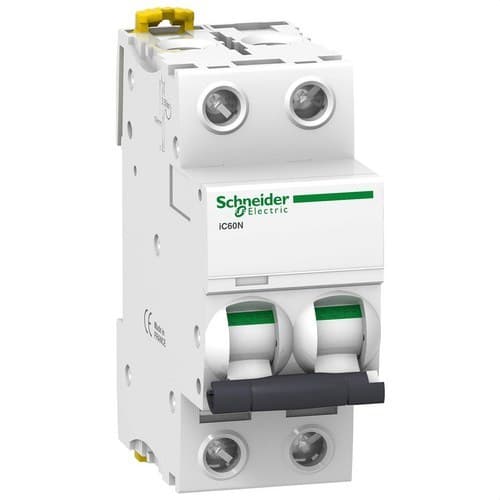
Information about IC60N Circuit Breaker 2P 32A Curve D
The Schneider Electric Acti9 iC60N A9F75232 circuit breaker is a modular 2-pole protected, 32 A, D-curve miniature circuit breaker designed to protect electrical circuits against overloads and short circuits. It offers a rated breaking capacity Icn of 6 kA at 400 V AC according to IEC/EN 60898-1 and an ultimate breaking capacity Icu of 10 kA at 380-415 V AC according to IEC/EN 60947-2, combining thermal-magnetic protection, high interrupting capacity, and a compact format for electrical panels.
The D curve allows it to withstand higher inrush transient currents than those typically permitted by B or C curves, making this reference especially suitable for circuits with loads that draw high starting currents, provided that the protection calculation and circuit impedance ensure tripping within the required times.
32 A bipolar circuit breaker
The Schneider Electric A9F75232 features 2 poles and 2 protected poles. This means that both conductors connected to the device are protected against overcurrent and are disconnected simultaneously when a trip occurs or when the operating lever is switched manually.
Its rated current is 32 A, so it must be installed in circuits whose conductors, loads, and installation conditions have been sized for this rating.
Thermal-magnetic protection
The Acti9 iC60N uses a thermal-magnetic trip unit that combines two protection mechanisms:
- Thermal protection: acts against sustained overloads that could cause excessive heating of the conductors.
- Magnetic protection: provides a fast response to high short-circuit currents.
This combination protects the circuit against the main risks caused by overcurrent.
D curve for high inrush currents
The A9F75232 reference incorporates a D tripping curve. Schneider Electric specifies a magnetic tripping threshold of 12 × In ±20%.
In a 32 A circuit breaker, this curve allows high current peaks during switching on to be tolerated without immediate magnetic tripping, always within the limits established by the curve.
The D curve may be suitable, after installation calculations, for loads such as:
- Motors with high starting current.
- Transformers.
- Equipment with high inrush currents.
- Certain inductive loads.
- Industrial machinery.
- Professional equipment with high transient peaks.
Choosing a D curve requires special verification of the minimum available short-circuit current at the end of the circuit, since its magnetic threshold is higher than that of a C curve.
6 kA breaking capacity according to IEC/EN 60898-1
According to IEC/EN 60898-1, the Schneider Electric A9F75232 has a rated breaking capacity Icn of 6,000 A at 400 V AC.
This is the value usually used as a reference for installations covered by this standard. The circuit breaker breaking capacity must be equal to or greater than the prospective short-circuit current at the installation point.
Breaking capacity according to IEC/EN 60947-2
The interrupting capacity is also specified according to IEC/EN 60947-2, commonly used in industrial and professional applications.
- 220-240 V AC: Icu of 20 kA.
- 380-415 V AC: Icu of 10 kA.
- 440 V AC: Icu of 6 kA.
- 100-133 V AC: Icu of 36 kA.
- Up to 125 V DC: Icu of 10 kA.
For this reason, the 6 kA and 10 kA values commercially associated with this reference are not contradictory: they correspond to different standards and test voltages.
Energy limiting class 3
The A9F75232 has energy limiting class 3 according to IEC/EN 60898-1.
This feature limits the energy and maximum current flowing through the circuit during a short circuit, reducing thermal and electrodynamic stress on downstream conductors and equipment.
VisiTrip for quickly locating faulty circuits
Schneider Electric VisiTrip technology makes it easy to visually identify the circuit breaker that has tripped due to a fault.
This indication can reduce the time needed to locate an issue in panels containing numerous circuits and protective devices.
VisiSafe for checking opening
The VisiSafe system allows visual confirmation of the physical opening of the contacts, providing an additional indication of the device status during maintenance operations.
The A9F75232 is also suitable for isolation in accordance with the applicable standards indicated by Schneider Electric.
Fast Closing mechanism
The Fast Closing mechanism makes the contact closing speed independent of how quickly the operating lever is manually actuated.
This feature helps reduce certain arc phenomena during closing and promotes greater contact durability.
Electrical characteristics
- Rated current In: 32 A.
- Number of poles: 2P.
- Protected poles: 2.
- Curve: D.
- Trip unit: thermal-magnetic.
- Magnetic threshold: 12 × In ±20%.
- Frequency: 50/60 Hz.
- Rated insulation voltage Ui: 500 V AC.
- Impulse withstand voltage Uimp: 6 kV.
- Utilization category: A.
- Overvoltage category: IV.
- Pollution degree: 3.
Compatible with AC and DC current
The iC60N A9F75232 has breaking characteristics specified for both AC and certain DC applications.
In DC, Schneider Electric specifies an Icu of 10 kA up to 125 V DC. The configuration, polarity, maximum voltage, and number of poles used must always be checked according to the specific application.
DIN rail mounting
The circuit breaker is designed for clip-on mounting on a DIN rail, making it easy to integrate into distribution and automation panels.
It occupies:
- 4 modules of 9 mm.
- 2 standard 18 mm modules.
- Total width: 36 mm.
Dimensions of the Schneider Electric A9F75232
- Height: 85 mm.
- Width: 36 mm.
- Depth: 78.5 mm.
- Weight: approximately 0.25 kg.
- Color: white.
Terminals for conductors up to 35 mm²
The device uses terminals that allow top or bottom feed and connection.
- Rigid conductor: 1 to 35 mm².
- Flexible conductor: 1 to 25 mm².
- Strip length: 14 mm.
- Tightening torque: 3.5 Nm.
Connections must be made respecting the conductor sizes, preparation, and tightening torques specified by the manufacturer.
Compatible with Acti9 comb busbars and accessories
The Acti9 iC60N design allows integration with different compatible Schneider Electric systems and accessories, including:
- Distribution comb busbars.
- Distribution blocks.
- Auxiliary contacts.
- Signal contacts.
- Auxiliary trip units.
- Remote monitoring systems.
- Compatible Vigi residual current blocks.
Exact compatibility must always be checked using the specific accessory reference.
Possibility of adding residual current protection
The A9F75232 is a circuit breaker and, by itself, does not include residual current protection against earth leakage currents.
When the installation requires residual current protection, it can be combined with a compatible Vigi block or used together with a suitably selected residual current device.
Mechanical and electrical durability
Schneider Electric specifies for the Acti9 iC60N:
- Mechanical durability: up to 20,000 cycles.
- Electrical durability: up to 10,000 cycles.
These features make it suitable for electrical panels where high service life and switching reliability are required.
IP20 protection rating
The A9F75232 has an IP20 protection rating as a standalone device according to IEC 60529.
Once correctly installed in a suitable enclosure, the front protection rating can reach IP40, depending on the panel used.
Environmental conditions
- Operating ambient temperature: -35 to 70 °C.
- Storage temperature: -40 to 85 °C.
- Relative humidity: up to 95% at 55 °C.
- Operating altitude: up to 2,000 m under the indicated conditions.
- Pollution degree: 3.
Applications of the Schneider Electric A9F75232
With its 32 A rating and D curve, this reference is especially intended for circuits that may present high inrush currents.
It can be used, provided that the electrical calculation confirms suitability, in:
- Motors.
- Transformers.
- Industrial machinery.
- Pumps.
- Compressors.
- Equipment with high starting currents.
- Automation panels.
- High-current industrial auxiliary circuits.
Technical characteristics of the Schneider Electric A9F75232
- Brand: Schneider Electric.
- Reference: A9F75232.
- Range: Acti9.
- Model: iC60N.
- Type: modular thermal-magnetic circuit breaker.
- Number of poles: 2P.
- Protected poles: 2.
- Rated current: 32 A.
- Tripping curve: D.
- Technology: thermal-magnetic.
- Magnetic threshold: 12 × In ±20%.
- Icn at 400 V according to IEC/EN 60898-1: 6 kA.
- Icu at 220-240 V according to IEC/EN 60947-2: 20 kA.
- Icu at 380-415 V according to IEC/EN 60947-2: 10 kA.
- Icu at 440 V according to IEC/EN 60947-2: 6 kA.
- Icu up to 125 V DC: 10 kA.
- Limiting class: 3.
- Frequency: 50/60 Hz.
- Network type: AC/DC.
- Insulation voltage Ui: 500 V.
- Impulse withstand voltage Uimp: 6 kV.
- Utilization category: A.
- Overvoltage category: IV.
- VisiTrip: yes.
- VisiSafe: yes.
- Fast Closing: yes.
- Suitable for isolation: yes.
- Mounting: DIN rail.
- Width: 36 mm.
- Height: 85 mm.
- Depth: 78.5 mm.
- Weight: approximately 0.25 kg.
- Rigid conductor: 1-35 mm².
- Flexible conductor: 1-25 mm².
- Tightening torque: 3.5 Nm.
- Protection rating: IP20.
- Mechanical durability: 20,000 cycles.
- Electrical durability: 10,000 cycles.
- Operating temperature: -35 to 70 °C.
- Storage temperature: -40 to 85 °C.
- EAN: 3606480080999.
- Main standards: IEC/EN 60898-1 and IEC/EN 60947-2.
Bipolar protection for loads with high starting currents
The Schneider Electric Acti9 iC60N A9F75232 combines 32 A, two protected poles, and a D curve in a compact format of only 36 mm width. Its high magnetic trip threshold makes it suitable for circuits with significant transient currents when the electrical characteristics of the installation are compatible.
VisiTrip, VisiSafe, Fast Closing, energy limiting class 3, and the possibility of adding Acti9 accessories complete a solution aimed at both distribution panels and professional and industrial applications.
Important: the D curve requires a sufficiently high fault current to ensure fast magnetic tripping. Before installing the A9F75232, check the 32 A rating, conductor cross-section, loop impedance, prospective short-circuit current, and required breaking capacity. This circuit breaker does not by itself provide residual current protection against earth leakage.
