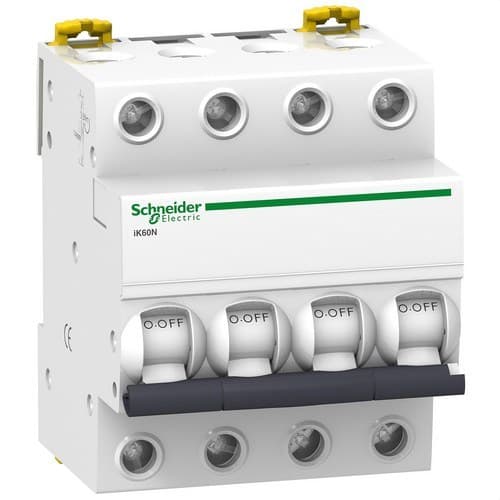
Information about IK60N 4P 20A C Curve 6kA Circuit Breaker
The Schneider Electric Acti9 iK60N A9K17420 miniature circuit breaker is a modular 4-pole, 20 A, C-curve circuit breaker designed to protect AC electrical circuits against overloads and short circuits. It features thermal-magnetic protection on all four poles and offers a rated breaking capacity Icn of 6 kA at 230 V AC according to EN/IEC 60898-1, making it a suitable solution for residential, commercial, and tertiary distribution boards.
It belongs to Schneider Electric’s Acti9 iK60 range and combines a modular DIN rail format with a C tripping curve, class 3 current limiting, and suitability for isolation. Its rated current is 20 A at 30 °C, and the magnetic trip threshold is between 5 and 10 times the rated current.
Main features of the Schneider Electric A9K17420
- Brand: Schneider Electric.
- Range: Acti9.
- Series: iK60.
- Model: iK60N.
- Reference: A9K17420.
- Type: modular thermal-magnetic circuit breaker.
- Number of poles: 4P.
- Protected poles: 4.
- Rated current: 20 A at 30 °C.
- Tripping curve: C.
- Tripping technology: thermal-magnetic.
- Network type: AC.
- Frequency: 50/60 Hz.
- Breaking capacity Icn: 6000 A at 230 V AC according to EN/IEC 60898-1.
- Service breaking capacity Ics: 6000 A, equivalent to 100% of Icn.
- Magnetic trip threshold: 5-10 x In.
- Current limiting class: 3.
- Rated insulation voltage Ui: 440 V AC.
- Impulse withstand voltage Uimp: 4 kV.
- Suitable for isolation: yes.
- Mounting: DIN rail.
- Width: 72 mm.
- Height: 85 mm.
- Depth: 78.5 mm.
- Weight: approximately 400 g.
- Protection rating: IP20.
4-pole 20 A protection
The A9K17420 has four poles, all of them protected by the thermal-magnetic trip unit. In the event of an overload, short circuit, or manual opening, the mechanism acts on the full set of poles to interrupt the circuit.
This configuration is suitable for installations where 4-pole protection is required within a single modular device.
Thermal and magnetic protection
The miniature circuit breaker combines two protection systems. The thermal trip responds to sustained overloads that can cause excessive heating of the conductors, while the magnetic trip acts quickly against high currents associated with a short circuit.
This combination helps protect downstream wiring and equipment against the main overcurrent conditions.
C curve with magnetic threshold of 5 to 10 times In
The A9K17420 reference uses a C tripping curve. Schneider Electric specifies a magnetic operating range between 5 and 10 times the rated current.
For a rated current of 20 A, this curve allows certain temporary current surges without unnecessary tripping, while still providing a fast response in the event of a short circuit. C curve is commonly used in general distribution circuits and loads with moderate inrush currents.
6 kA breaking capacity
Schneider Electric specifies a rated breaking capacity Icn of 6000 A at 230 V AC and 50/60 Hz in accordance with EN/IEC 60898-1.
The service breaking capacity Ics is also 6000 A, equivalent to 100% of Icn under the manufacturer’s stated conditions.
The breaker’s breaking capacity must be equal to or greater than the prospective short-circuit current at the installation point.
Class 3 current limiting
The Acti9 iK60N A9K17420 features class 3 current limiting in accordance with EN/IEC 60898-1. This characteristic helps limit the energy flowing through the circuit during a short circuit.
High current-limiting performance helps reduce thermal and electrodynamic stress on conductors and other downstream components.
Suitable for isolation
Schneider Electric specifies the A9K17420 as suitable for isolation according to EN/IEC 60898-1. This allows the device to be used to electrically isolate the circuit within the conditions established by the standard and the manufacturer.
Operation is via a front lever and includes local ON/OFF indication, making the operating status easy to identify visually.
Rated current of 20 A
The breaker’s rated current is 20 A at a reference temperature of 30 °C. To select the correct protection, it must be verified that this rating is suitable for the conductor cross-section, the expected load, and the actual installation conditions.
Factors such as ambient temperature, circuit grouping, and installation method can affect cable current-carrying capacity and must be taken into account during sizing.
Insulation voltage and impulse withstand voltage
The device has a rated insulation voltage Ui of 440 V AC at 50/60 Hz and an impulse withstand voltage Uimp of 4 kV.
These characteristics define its dielectric capability under the conditions established by EN/IEC 60898-1.
Modular DIN rail mounting
The A9K17420 is designed for clip-on mounting on a DIN rail. It occupies 8 modules of 9 mm, equivalent to four standard 18 mm modules.
- Width: 72 mm.
- Height: 85 mm.
- Depth: 78.5 mm.
- Weight: approximately 400 g.
- Color: white.
Its modular format makes it easy to integrate alongside residual current devices and other protection and control devices inside the electrical panel.
Terminals for top or bottom connection
The miniature circuit breaker uses tunnel terminals and allows connection from the top or bottom.
- Rigid conductor: 1 to 25 mm².
- Flexible conductor: 1 to 16 mm².
- Strip length: 14 mm.
- Tightening torque: 3.5 Nm.
The conductor cross-section must be selected according to the design current, voltage drop, temperature, installation method, and applicable electrical regulations.
High durability
Schneider Electric specifies high resistance to opening and closing operations:
- Mechanical durability: up to 20,000 cycles.
- Electrical durability: up to 10,000 cycles.
These features allow the breaker to be used for a high number of operations within the established service conditions.
Padlock locking option
The technical documentation includes the use of a padlock locking device. This option allows the operating lever to be mechanically locked when installation maintenance or safety conditions require it.
IP20 protection rating
The A9K17420 has an IP20 protection rating according to IEC 60529. It is intended to be installed inside an enclosure or electrical panel that provides the necessary level of protection for the environment.
The manufacturer also specifies a pollution degree 2 and an overvoltage category III.
Wide temperature range
The miniature circuit breaker is designed to operate across a wide range of environmental conditions:
- Operating ambient temperature: -25 to +60 °C.
- Storage temperature: -40 to +85 °C.
Under special temperature or grouping conditions, the sizing recommendations indicated by Schneider Electric should be checked.
No integrated residual current protection
The A9K17420 provides protection against overloads and short circuits, but it does not include residual current protection against earth leakage.
When the installation requires residual current protection, it must be combined with a suitable residual current device, selected according to the sensitivity, class, and characteristics required for the circuit.
Applications of the Schneider Electric iK60N A9K17420
Thanks to its 4-pole configuration, 20 A rating, and C curve, this miniature circuit breaker can be used in:
- Electrical distribution boards.
- Residential installations.
- Commercial premises.
- Tertiary buildings.
- Three-phase circuits and configurations requiring four-pole disconnection.
- Protection of lines and equipment against overcurrents.
- Installations requiring C curve.
- Modular panels on DIN rail.
Technical data of the Schneider Electric A9K17420
- Manufacturer: Schneider Electric.
- Reference: A9K17420.
- Range: Acti9.
- Series: iK60.
- Model: iK60N.
- Type: modular miniature circuit breaker.
- Number of poles: 4P.
- Protected poles: 4.
- Rated current: 20 A at 30 °C.
- Curve: C.
- Tripping technology: thermal-magnetic.
- Magnetic threshold: 5-10 x In.
- Network type: AC.
- Frequency: 50/60 Hz.
- Icn: 6000 A at 230 V AC.
- Ics: 6000 A, 100% of Icn.
- Current limiting class: 3.
- Ui: 440 V AC.
- Uimp: 4 kV.
- Suitable for isolation: yes.
- Control: lever.
- Indication: ON/OFF indication.
- Mounting: clip-on DIN rail.
- 9 mm modules: 8.
- Width: 72 mm.
- Height: 85 mm.
- Depth: 78.5 mm.
- Weight: approximately 400 g.
- Color: white.
- Rigid conductor: 1-25 mm².
- Flexible conductor: 1-16 mm².
- Strip length: 14 mm.
- Tightening torque: 3.5 Nm.
- Mechanical durability: 20,000 cycles.
- Electrical durability: 10,000 cycles.
- Integrated residual current protection: no.
- Protection rating: IP20.
- Pollution degree: 2.
- Overvoltage category: III.
- Operating temperature: -25 to +60 °C.
- Storage temperature: -40 to +85 °C.
- Standard: EN/IEC 60898-1.
- Product certification: AENOR.
4-pole Acti9 iK60N miniature circuit breaker for distribution boards
The Schneider Electric A9K17420 combines four protected poles, a 20 A rated current, C curve, and 6 kA breaking capacity in a modular four-DIN-module format. Its thermal-magnetic protection acts against overloads and short circuits, while class 3 current limiting and suitability for isolation complete its protection features.
With a mechanical life of up to 20,000 cycles, terminals for rigid conductors up to 25 mm², and operation between -25 and +60 °C, it is ready to be integrated into low-voltage distribution boards where 20 A 4-pole protection is required.
To ensure proper protection, the circuit breaker must be selected taking into account the conductor cross-section, the expected circuit current, the available short-circuit current, and the actual installation conditions.
