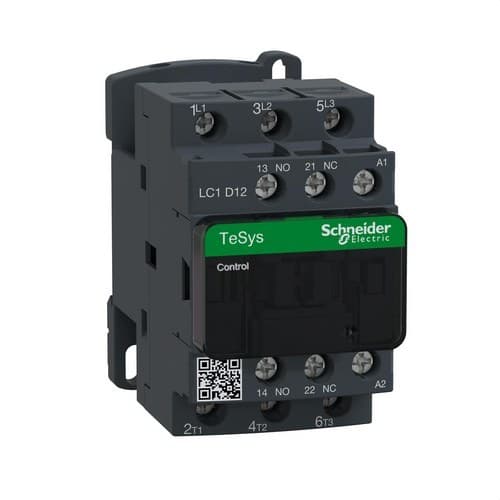
Information about Contactor 12A 1 NO/1 NC 230V 50-60HZ
The Schneider Electric LC1D12P7 is a three-pole contactor from the TeSys D / TeSys Deca range, designed for motor control and resistive loads in industrial, commercial, and HVAC electrical applications. It features 3 normally open main poles (3 NO), a rated operational current of 12 A in AC-3 category, and a 230 V AC control coil at 50/60 Hz.
This contactor can control three-phase motors up to 5.5 kW at 380-400 V AC in AC-3 category and comes standard with 2 integrated auxiliary contacts, 1 NO + 1 NC, making it easy to use in interlocking, signaling, automation, and switching circuits. Its compact design, screw terminals, and the option for rail or panel mounting make the LC1D12P7 a versatile solution for electrical panels and control systems.
12 A three-phase contactor for motor control
The LC1D12P7 includes 3 normally open main contacts for switching three-phase loads. Its rated operational current reaches 12 A at temperatures up to 60 °C for AC-3 loads and voltages up to 440 V AC.
For resistive loads in AC-1 category, the contactor supports a rated operational current of up to 25 A at 60 °C and up to 440 V AC. It is also suitable for AC-3 and AC-4 applications, expanding its use in drive and automation systems.
Motor power according to supply voltage
The motor power the contactor can control depends on the operating voltage. According to Schneider Electric specifications, its main AC-3 values are:
- 3 kW at 220-230 V AC, 50/60 Hz.
- 5.5 kW at 380-400 V AC, 50/60 Hz.
- 5.5 kW at 415-440 V AC, 50/60 Hz.
- 7.5 kW at 500 V AC, 50/60 Hz.
- 7.5 kW at 660-690 V AC, 50/60 Hz.
In AC-4 category, it supports a power rating of 3.7 kW at 400 V AC. These capabilities make the LC1D12P7 suitable for many direct-on-line starting and electric motor switching applications.
230 V AC 50/60 Hz control coil
The LC1D12P7 stands out within the TeSys family by incorporating a 230 V AC control coil compatible with 50 and 60 Hz networks. This allows direct integration into many control circuits used in machinery, electrical panels, and HVAC systems.
The coil holding power consumption is approximately 7 VA at 50 Hz and 7.5 VA at 60 Hz, while the inrush power is approximately 70 VA. The coil does not include an integrated suppression module.
Integrated auxiliary contacts 1 NO + 1 NC
In addition to its three main power contacts, the Schneider Electric LC1D12P7 contactor includes one normally open auxiliary contact and one normally closed auxiliary contact as standard.
These auxiliary contacts can be used for self-holding circuits, contactor status indication, interlocking other equipment, or sending signals to relays, PLCs, and other control devices.
The auxiliary contacts are mechanically linked in accordance with IEC 60947-5-1, and the normally closed contact has mirror contact function in accordance with IEC 60947-4-1.
Electrical ratings and operating voltage
- Rated operational voltage of the power circuit: up to 690 V AC, 25-400 Hz.
- Maximum DC voltage: up to 300 V DC in the power circuit.
- AC-3 rated current: 12 A up to 440 V AC.
- AC-1 rated current: 25 A up to 440 V AC.
- Conventional thermal current: 25 A for the power circuit.
- Conventional thermal current for signaling: 10 A.
- Rated insulation voltage Ui: 690 V according to IEC 60947.
- Rated impulse withstand voltage Uimp: 6 kV according to IEC 60947.
Installation with screw terminals
The contactor is equipped with screw terminals for both the power and control circuits. This system ensures a secure conductor connection and allows integration into conventional electrical panels.
It accepts rigid or flexible conductors of different cross-sections, with connection capacities of up to 4 mm² depending on the type and number of conductors installed. The specified tightening torque for the main and control terminals is approximately 1.7 Nm.
Compact panel mounting
The LC1D12P7 can be installed on a DIN rail or directly on a panel. Its compact format helps reduce the space occupied inside the control cabinet while maintaining high switching capacity.
- Width: 45 mm.
- Height: 77 mm.
- Depth: 86 mm.
- Approximate weight: 0.325 kg.
- Front protection rating: IP20 according to IEC 60529.
High durability for professional applications
Schneider Electric specifies a mechanical durability of up to 15 million cycles for this contactor. Electrical durability reaches approximately 2 million cycles at 12 A in AC-3 category and operating voltage up to 440 V.
It can achieve an operating frequency of up to 3,600 cycles per hour at temperatures up to 60 °C, making it suitable for professional applications that require a high switching frequency.
Operating conditions
The LC1D12P7 is designed to operate in demanding industrial conditions. Its ambient operating temperature range is -5 to 60 °C under the manufacturer’s specified rated conditions, and it can be used at altitudes of up to 3,000 meters without temperature derating.
The enclosure has fire resistance up to 850 °C according to IEC 60695-2-1 and a V1 flame-retardant rating according to UL 94.
Technical characteristics of the Schneider Electric LC1D12P7
- Brand: Schneider Electric.
- Reference: LC1D12P7.
- Range: TeSys D / TeSys Deca.
- Product type: contactor.
- Application: motor control and resistive loads.
- Number of poles: 3P.
- Main contacts: 3 NO.
- AC-3 rated current: 12 A up to 440 V AC.
- AC-1 rated current: 25 A up to 440 V AC.
- Control coil: 230 V AC.
- Coil frequency: 50/60 Hz.
- Auxiliary contacts: 1 NO + 1 NC.
- Motor power at 220-230 V AC: 3 kW.
- Motor power at 380-400 V AC: 5.5 kW.
- Motor power at 415-440 V AC: 5.5 kW.
- Operating voltage: up to 690 V AC.
- Insulation voltage Ui: 690 V.
- Rated impulse withstand voltage Uimp: 6 kV.
- Terminals: screw.
- Mounting: rail or panel.
- Protection rating: IP20 on the front face.
- Width: 45 mm.
- Height: 77 mm.
- Depth: 86 mm.
- Weight: approximately 0.325 kg.
- Mechanical durability: up to 15 million cycles.
- Electrical durability: up to 2 million cycles at 12 A in AC-3.
- Operating temperature: -5 to 60 °C.
- Main standards: IEC/EN 60947-4-1 and IEC/EN 60947-5-1.
Applications of the LC1D12P7 contactor
The Schneider Electric LC1D12P7 12 A contactor is especially suitable for controlling electric motors, pumps, fans, compressors, HVAC systems, machinery, and other three-phase loads. It can also be used for switching resistive loads within the specified electrical limits.
Its combination of a 230 V AC coil, 3 power poles, 1 NO + 1 NC auxiliary contacts, and motor capacity up to 5.5 kW at 400 V provides a compact and reliable solution for automation and control panels in both new installations and maintenance or replacement work.
