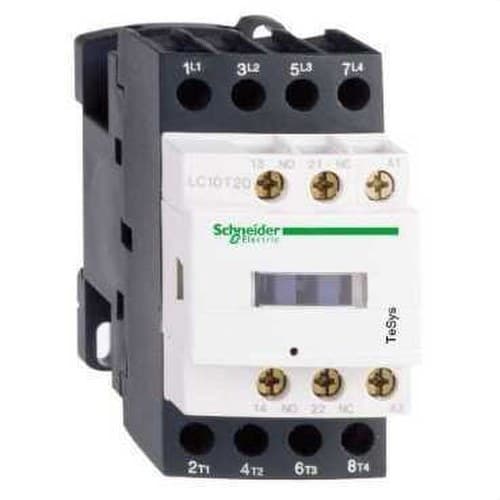
Information about Contactor 20A 1 NO/1 NC 230V 50-60HZ 4P
The Schneider Electric TeSys Deca LC1DT20P7 contactor is a power contactor with 4 poles and 4 normally open main contacts, designed primarily for switching non-inductive or slightly inductive loads. It offers a rated operational current of 20 A in AC-1 category up to 440 V, includes a 230 V AC control coil at 50/60 Hz, and comes standard with 1 NO auxiliary contact + 1 NC auxiliary contact. Its screw terminal connection and DIN rail or panel mounting make it easy to integrate into electrical control, heating, HVAC, and automation panels.
The LC1DT20P7 reference belongs to Schneider Electric's TeSys Deca range and is especially suitable for frequent switching of circuits with resistive loads, such as electric heating systems and certain HVAC applications. Its compact design, only 45 mm wide, allows four power poles and two integrated auxiliary contacts to fit in very little space inside the electrical cabinet.
4-pole contactor with 4 NO main contacts
The LC1DT20P7 incorporates 4 normally open main poles (4 NO). When the coil is de-energized, the four contacts remain open and the load is disconnected. When the coil is energized, the electromagnetic mechanism closes all four poles simultaneously.
This configuration makes it possible to control circuits that require the simultaneous opening and closing of four conductors, always within the electrical characteristics specified by Schneider Electric.
20 A in AC-1 category
The rated operational current of this reference is 20 A in AC-1 category up to 440 V.
AC-1 category is mainly intended for non-inductive or slightly inductive loads with a high power factor. Typical applications include:
- Electric resistors.
- Heating systems.
- Air conditioning equipment with compatible loads.
- Resistive power circuits.
- Certain industrial lighting and heating systems.
- Automation and control panels.
The 20 A rating applies to AC-1 category. Schneider Electric does not publish an AC-3 motor rating for this reference, so it should not automatically be interpreted as a 20 A motor contactor.
230 V AC control coil
The P7 suffix identifies the version equipped with a 230 V AC control coil at 50/60 Hz.
This control voltage allows the contactor to be operated by different compatible devices, such as:
- Thermostats.
- Control relays.
- Time switches.
- Pressure switches.
- PLCs with the appropriate output.
- Switches and auxiliary circuits.
- HVAC management systems.
When the coil receives the control voltage, the four main poles switch to the closed position. When the voltage is removed, the mechanism returns the contacts to the open position.
Integrated auxiliary contacts 1 NO + 1 NC
In addition to the four power main contacts, the LC1DT20P7 includes as standard:
- 1 normally open auxiliary contact.
- 1 normally closed auxiliary contact.
These auxiliary contacts are intended for signaling, interlocking, and control tasks and should not be confused with the four main poles.
The complete contactor configuration is therefore:
- Main contacts: 4 NO.
- Auxiliary contacts: 1 NO + 1 NC.
NC auxiliary contact with mirror function
The 1 NO + 1 NC auxiliary contacts are mechanically linked in accordance with IEC 60947-5-1.
Schneider Electric also specifies that the normally closed auxiliary contact has a mirror contact function in accordance with IEC 60947-4-1, a feature useful for certain contactor status monitoring functions within a properly designed control system.
Power circuit up to 690 V
The contactor is designed for low-voltage power circuits and has the following dielectric characteristics:
- Rated insulation voltage Ui: 690 V according to IEC.
- Rated impulse withstand voltage Uimp: 6 kV.
- Overvoltage category: III.
- Pollution degree: 3.
The 20 A AC-1 operational current is specified for voltages up to 440 V, while the device's maximum insulation values reach 690 V.
Making and breaking capacity
Schneider Electric specifies for the main circuit a rated making capacity of 250 A at 440 V and a rated breaking capacity of 250 A at 440 V in accordance with IEC 60947.
These values describe the switching performance of the contactor and should not be confused with short-circuit breaking capacity. The LC1DT20P7 does not replace a fuse or circuit breaker.
Short-time withstand current
The following short-time withstand current values are specified for the main circuit:
- 210 A for 1 second.
- 105 A for 10 seconds.
- 61 A for 1 minute.
- 30 A for 10 minutes.
These values are relevant when studying coordination between the contactor and the panel's short-circuit protection devices.
Fuse coordination
The technical documentation includes the use of gG fuses associated with the main circuit:
- 25 A gG: type 1 coordination up to 690 V.
- 20 A gG: type 2 coordination up to 690 V.
- 10 A gG: for the signaling circuit according to IEC 60947-5-1.
Final protection must be selected according to the circuit, expected short-circuit current, and installation coordination requirements.
Screw terminal connection
The Schneider Electric LC1DT20P7 uses screw terminals for both the power circuit and the auxiliary circuit.
Depending on the type and number of conductors, it accepts cross-sections of approximately:
- Rigid conductor: 1-4 mm².
- Flexible conductor without ferrule: 1-4 mm².
- Flexible conductor with ferrule: up to 4 mm² with one conductor.
- Two flexible conductors with ferrule: up to 2.5 mm² per conductor.
The specified tightening torque is approximately 1.7 Nm for screw connections, depending on the terminal and tool used.
DIN rail or panel mounting
The contactor supports two common installation methods:
- DIN rail mounting.
- Screw mounting on a panel.
This versatility makes it easy to incorporate into both industrial enclosures and HVAC panels and building control systems.
Compact 45 mm format
The TeSys Deca LC1DT20P7 offers four power poles in compact dimensions:
- Width: 45 mm.
- Height: 85 mm.
- Depth: 92 mm.
- Weight: approximately 0.365 kg.
Its reduced width makes it easier to install multiple contactors in space-limited panels.
Coil consumption
The 230 V AC coil has the following approximate consumption values:
- Inrush consumption at 50 Hz: 70 VA.
- Inrush consumption at 60 Hz: 70 VA.
- Holding consumption at 50 Hz: 7 VA.
- Holding consumption at 60 Hz: 7.5 VA.
- Thermal dissipation: approximately 2-3 W.
These data are useful when sizing transformers and auxiliary circuits that supply several contactors simultaneously.
Coil operating limits
Schneider Electric specifies the following approximate limits for the control circuit:
- Operation at 50 Hz: 0.8-1.1 × Uc between -40 and 60 °C.
- Operation at 60 Hz: 0.85-1.1 × Uc between -40 and 60 °C.
- Drop-out: 0.3-0.6 × Uc.
Fast switching times
The electromagnetic mechanism provides short response times:
- Closing time: approximately 12-22 ms.
- Opening time: approximately 4-19 ms.
The fast response makes it suitable for automatic circuits where repeated switching commands are carried out within the established limits.
Up to 3,600 cycles per hour
The LC1DT20P7 supports a maximum operating frequency of up to 3,600 cycles per hour at 60 °C, within the conditions specified by Schneider Electric.
This capability makes it suitable for systems with a high number of switching operations, provided that the load and the electrical life of the assembly are compatible.
15 million mechanical cycles
Schneider Electric specifies a mechanical durability of up to 15 million cycles.
This high mechanical endurance is intended for professional installations where the contactor may perform numerous operations throughout its service life.
IP20 protection rating
The front of the contactor has an IP20 protection rating in accordance with IEC 60529.
As a component for panel integration, it must be installed inside an enclosure that provides the necessary level of protection against dust, moisture, and contact with live parts.
Wide temperature range
The technical documentation includes:
- Normal operating temperature: up to 60 °C.
- Operation from 60 to 70 °C: possible with restrictions.
- Storage temperature: -60 to 80 °C.
- Maximum operating altitude: up to 3,000 m.
Resistance to vibration and shock
The TeSys Deca LC1DT20P7 is designed for professional applications and offers mechanical resistance to vibration and shock:
- Vibration with contactor open: 2 gn between 5 and 300 Hz.
- Vibration with contactor closed: 4 gn between 5 and 300 Hz.
- Shock with contactor closed: 15 gn for 11 ms.
- Shock with contactor open: 10 gn for 11 ms.
Applications of the Schneider Electric LC1DT20P7
Due to its four-pole configuration and AC-1 category, this reference is especially suitable for switching resistive loads and certain electrical and HVAC applications.
Possible uses include:
- Electric heating.
- Resistor banks.
- HVAC systems.
- Air conditioning.
- Control panels.
- Building automation.
- Switching four-pole circuits.
- Non-inductive or slightly inductive loads.
Technical features of the Schneider Electric LC1DT20P7
- Brand: Schneider Electric.
- Reference: LC1DT20P7.
- Range: TeSys Deca.
- Short name: LC1D.
- Type: power contactor.
- Main application: AC-1 loads and compatible HVAC applications.
- Number of poles: 4P.
- Main contacts: 4 NO.
- Auxiliary contacts: 1 NO + 1 NC.
- AC-1 rated current: 20 A up to 440 V.
- Coil voltage: 230 V AC.
- Coil frequency: 50/60 Hz.
- Rated insulation voltage Ui: 690 V according to IEC.
- Rated impulse withstand voltage Uimp: 6 kV.
- Overvoltage category: III.
- Pollution degree: 3.
- Making capacity: 250 A at 440 V.
- Breaking capacity: 250 A at 440 V.
- Average power circuit impedance: approximately 2.5 mΩ.
- Power dissipation per pole: approximately 1.56 W in AC-1.
- Terminals: screw terminals.
- Mounting: DIN rail or panel.
- Width: 45 mm.
- Height: 85 mm.
- Depth: 92 mm.
- Weight: approximately 0.365 kg.
- Inrush consumption: approximately 70 VA.
- Holding consumption: 7-7.5 VA.
- Coil dissipation: approximately 2-3 W.
- Closing time: 12-22 ms.
- Opening time: 4-19 ms.
- Mechanical durability: up to 15 million cycles.
- Maximum switching frequency: 3,600 cycles/h.
- Front protection rating: IP20.
- Maximum altitude: up to 3,000 m.
- EAN: 3389110244526.
- Main standards: IEC/EN 60947-4-1, IEC/EN 60947-5-1, and IEC 60335-1.
Four-pole contactor for heating and AC-1 loads
The Schneider Electric TeSys Deca LC1DT20P7 combines four normally open main contacts, 20 A AC-1 capacity, a 230 V AC coil, and 1 NO + 1 NC auxiliaries in a device only 45 mm wide. These features make it ideal for controlling electric heating, resistive loads, HVAC, and four-pole circuits in professional panels.
The integrated auxiliary contacts simplify signaling and interlocking circuits, while the screw terminals, DIN rail or panel mounting, and mechanical durability of up to 15 million cycles make it easy to incorporate into automation and control systems.
Important: the 20 A rating applies to AC-1 category. The main contacts are 4 NO, while the 1 NO + 1 NC commonly indicated in the commercial designation refers to auxiliary contacts. This contactor does not include overload or short-circuit protection and must be combined with the appropriate protection devices for the load and installation.
