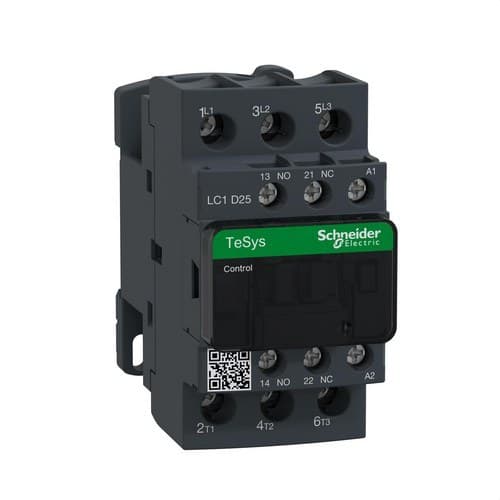
Information about Contactor 25A 1 NO/1 NC 24V 50-60HZ
The Schneider Electric LC1D25B7 contactor from the TeSys Deca range is a three-pole contactor designed for controlling electric motors and resistive loads in automation panels, machinery, HVAC systems, and industrial installations. It offers a rated operational current of 25 A in AC-3 and AC-3e categories up to 440 V, incorporates a 24 V AC control coil at 50/60 Hz, and can control three-phase motors up to 11 kW at 380-400 V.
The device features 3 normally open main contacts for the power circuit and comes as standard with 1 normally open auxiliary contact and 1 normally closed auxiliary contact. This configuration enables self-holding, signaling, interlocking, and feedback functions to automation systems without initially needing an external auxiliary block.
Main features of the Schneider Electric LC1D25B7
- Brand: Schneider Electric.
- Range: TeSys.
- Family: TeSys Deca.
- Reference: LC1D25B7.
- Product type: power contactor.
- Application: motor and resistive load control.
- Number of poles: 3P.
- Main contacts: 3 NO.
- Integrated auxiliary contacts: 1 NO + 1 NC.
- Rated current AC-3/AC-3e: 25 A up to 440 V.
- Rated current AC-1: 40 A up to 440 V.
- Coil voltage: 24 V AC.
- Coil frequency: 50/60 Hz.
- Motor power at 380-400 V: 11 kW in AC-3.
- Power circuit operational voltage: up to 690 V AC.
- Mounting: DIN rail or plate.
- Terminals: screw terminals.
- Front protection rating: IP20.
- Dimensions: 45 x 85 x 92 mm.
- Weight: approximately 0.37 kg.
25 A TeSys Deca contactor
The LC1D25B7 is part of Schneider Electric’s TeSys Deca platform, developed for professional motor switching and control applications. Its design allows a high number of electrical operations while maintaining a compact width of just 45 mm.
In AC-3 utilization category, the contactor supports an operational current of 25 A up to 440 V and 60 °C. This category is mainly used for squirrel-cage motors in applications where the contactor closes the starting current and opens the circuit while the motor is running normally.
Up to 11 kW motor power at 400 V
The admissible motor power depends on the supply voltage. Schneider Electric specifies the following values in AC-3 category:
- 220-230 V AC: 5.5 kW.
- 380-400 V AC: 11 kW.
- 415-440 V AC: 11 kW.
- 500 V AC: 15 kW.
- 660-690 V AC: 15 kW.
- 400 V AC in AC-4: 5.5 kW.
In standard 400 V three-phase networks, this reference can therefore control motors up to 11 kW in AC-3, provided the motor’s actual current and service conditions are compatible with the contactor specifications.
24 V AC control coil
The B7 suffix identifies this version with a 24 V AC coil at 50/60 Hz. This control voltage is common in industrial panels and automation systems where the control circuit is kept at a lower voltage than the power circuit.
When the coil is energized, the electromagnet closes the three main contacts and changes the state of the auxiliary contacts. When the control voltage disappears, the mechanism returns to its rest position.
Coil operating range
Schneider Electric specifies the following voltage limits for the coil:
- Operation at 50 Hz: from 0.8 to 1.1 times Uc.
- Operation at 60 Hz: from 0.85 to 1.1 times Uc.
- Drop-out: from 0.3 to 0.6 times Uc.
These ranges are specified for the temperature conditions defined by the manufacturer and must be respected to ensure reliable switching.
3 normally open main contacts
The power circuit includes three normally open contacts, one for each phase. When the coil is de-energized, the contacts remain open; when the control command is received, they close simultaneously to supply the load.
The 1 NO + 1 NC indicated in the commercial designation refers to the integrated auxiliary contacts, not the main power contacts.
1 NO + 1 NC integrated auxiliary contacts
The LC1D25B7 includes two auxiliary contacts as standard:
- 1 normally open contact.
- 1 normally closed contact.
These contacts allow functions such as self-holding, run indication, electrical interlocking, status feedback to PLCs, and auxiliary relay control.
Schneider Electric specifies that both contacts are mechanically linked in accordance with IEC 60947-5-1 and that the NC contact has a mirror contact function in accordance with IEC 60947-4-1.
25 A in AC-3 and 40 A in AC-1
The permissible current of the contactor depends on the utilization category:
- AC-3 / AC-3e: 25 A up to 440 V.
- AC-1: 40 A up to 440 V.
AC-3 is mainly used for motor control, while AC-1 applies to non-inductive or slightly inductive loads, such as certain resistive loads.
Operational voltage up to 690 V AC
The power circuit is designed for a rated operational voltage of up to 690 V AC over a frequency range of 25 to 400 Hz. It also supports DC applications up to 300 V within the configurations defined by Schneider Electric.
The rated insulation voltage is 690 V according to IEC 60947-4-1 and the rated impulse withstand voltage Uimp is 6 kV. The device belongs to overvoltage category III.
Conventional thermal current of 40 A
Schneider Electric specifies a conventional free-air thermal current Ith of 40 A up to 60 °C for the main circuit.
For the signaling auxiliary circuit, the specified conventional thermal current is 10 A at temperatures up to 60 °C.
Making and breaking capacity of 450 A
The LC1D25B7 has a rated making capacity of 450 A at 440 V for the power circuit in accordance with IEC 60947.
The rated breaking capacity also reaches 450 A at 440 V. These ratings allow the contactor to withstand the high currents that occur during certain motor switching operations.
Short-time current withstand
The technical documentation specifies different short-time current withstand values for the power circuit:
- 380 A for 1 second.
- 240 A for 10 seconds.
- 120 A for 1 minute.
- 50 A for 10 minutes.
These values are part of the contactor’s thermal withstand characteristics and do not replace upstream short-circuit protection devices.
Fuse coordination
Schneider Electric specifies the following fuse associations for the power circuit:
- 40 A gG: type 2 coordination up to 690 V.
- 63 A gG: type 1 coordination up to 690 V.
For the auxiliary circuit, a 10 A gG fuse is specified in accordance with IEC 60947-5-1.
The final selection of protection devices must be made based on the manufacturer’s coordination tables and the actual motor and installation conditions.
High electrical and mechanical durability
The contactor is designed to withstand a high number of operations:
- Mechanical durability: up to 15 million cycles.
- Electrical durability in AC-3 at 25 A: approximately 1.65 million cycles.
- Electrical durability in AC-1 at 40 A: approximately 1.4 million cycles.
- Maximum switching frequency: up to 3600 cycles/hour at 60 °C.
These characteristics make the LC1D25B7 suitable for applications with frequent switching within the limits established by Schneider Electric.
Coil consumption
The 24 V AC coil has a higher consumption at pull-in and a reduced consumption when the contactor remains energized:
- Inrush power: approximately 70 VA at 50/60 Hz.
- Holding consumption at 50 Hz: approximately 7 VA.
- Holding consumption at 60 Hz: approximately 7.5 VA.
- Thermal dissipation: approximately 2-3 W.
These values should be considered when sizing the transformer or control power supply if several contactors are installed.
Opening and closing times
The electromagnetic mechanism offers short operating times:
- Closing time: 12 to 22 ms.
- Opening time: 4 to 19 ms.
This speed allows the contactor to be integrated into automation and control systems where immediate response to control commands is required.
DIN rail or plate mounting
The LC1D25B7 offers two main mounting options:
- DIN rail mounting.
- Screw fixing on a plate.
This flexibility makes installation easier in both modular panels and industrial automation enclosures.
Screw terminals
The contactor uses screw terminals for both the power circuit and the control circuit.
In the main circuit, depending on the type and number of conductors used, it accepts cross-sections of up to 10 mm². The control circuit accepts conductors up to 4 mm² in certain configurations.
The specified tightening torques are:
- Power circuit: 2.5 Nm.
- Control circuit: 1.7 Nm.
Compact dimensions
The Schneider Electric LC1D25B7 maintains a compact format that helps optimize the available space in the panel:
- Width: 45 mm.
- Height: 85 mm.
- Depth: 92 mm.
- Weight: approximately 0.37 kg.
Its width of just 45 mm allows several contactors to be installed side by side in electrical cabinets with high component density.
IP20 front protection rating
The front face of the device has an IP20 protection rating in accordance with IEC 60529. The contactor must be installed inside a panel or enclosure that provides the appropriate level of protection for the operating environment.
Schneider Electric also specifies TH treatment in accordance with IEC 60068-2-30 and pollution degree 3.
Environmental conditions
- Operating ambient temperature: -5 to +60 °C.
- Storage temperature: -60 to +80 °C.
- Coil storage temperature: -40 to +70 °C.
- Operating altitude: up to 3000 m without temperature derating.
- Fire resistance: 850 °C according to IEC 60695-2-1.
- Flammability rating: V1 according to UL 94.
Compatible with TeSys Deca accessories
The TeSys platform allows the LC1D25B7 to be completed with various accessories depending on panel requirements, including:
- Motor thermal overload relays.
- Additional auxiliary blocks.
- Time-delay modules.
- Coil surge suppressors.
- Mechanical interlocks.
- Reversing accessories.
- Connection and mounting accessories.
The exact accessory compatibility must be checked against the contactor size and version.
Applications of the Schneider Electric LC1D25B7
The contactor can be used in many professional applications, including:
- Direct starting of three-phase motors.
- Pumps and booster sets.
- Fans and extractors.
- Compressors.
- HVAC and air conditioning systems.
- Industrial machinery.
- Conveyor belts.
- Automation panels.
- PLC-based control systems.
- Compatible resistive loads.
Standards and certifications
The LC1D25B7 is designed in accordance with various international standards applicable to contactors and switching devices:
- IEC 60947-4-1.
- IEC 60947-5-1.
- EN 60947-4-1.
- EN 60947-5-1.
- UL 508.
- CSA C22.2 No. 14.
The manufacturer’s documentation also includes international certifications for different markets and industrial applications.
Technical data for the Schneider Electric LC1D25B7
- Manufacturer: Schneider Electric.
- Reference: LC1D25B7.
- EAN: 3389110349658.
- Range: TeSys.
- Family: TeSys Deca.
- Type: contactor.
- Application: motor and resistive load control.
- Utilization categories: AC-1, AC-3, AC-3e and AC-4.
- Number of poles: 3P.
- Main contacts: 3 NO.
- Auxiliary contacts: 1 NO + 1 NC.
- AC-3/AC-3e current: 25 A up to 440 V.
- AC-1 current: 40 A up to 440 V.
- Coil voltage: 24 V AC.
- Coil frequency: 50/60 Hz.
- Motor at 220-230 V: 5.5 kW.
- Motor at 380-400 V: 11 kW.
- Motor at 415-440 V: 11 kW.
- Motor at 500 V: 15 kW.
- Motor at 660-690 V: 15 kW.
- Motor at 400 V in AC-4: 5.5 kW.
- Maximum AC operational voltage: 690 V.
- Maximum DC operational voltage: 300 V.
- Ui: 690 V according to IEC.
- Uimp: 6 kV.
- Overvoltage category: III.
- Ith power circuit: 40 A at 60 °C.
- Ith auxiliary circuit: 10 A at 60 °C.
- Making capacity: 450 A at 440 V.
- Breaking capacity: 450 A at 440 V.
- Mechanical durability: 15 million cycles.
- Electrical durability AC-3: approximately 1.65 million cycles.
- Maximum frequency: 3600 cycles/hour.
- Coil inrush power: approximately 70 VA.
- Holding consumption: 7 VA at 50 Hz / 7.5 VA at 60 Hz.
- Closing time: 12-22 ms.
- Opening time: 4-19 ms.
- Mounting: DIN rail or plate.
- Connection: screw terminals.
- Width: 45 mm.
- Height: 85 mm.
- Depth: 92 mm.
- Weight: approximately 0.37 kg.
- Front protection: IP20.
- Operating temperature: -5 to +60 °C.
- Storage temperature: -60 to +80 °C.
25 A TeSys Deca contactor with 24 V AC coil
The Schneider Electric LC1D25B7 combines a rated current of 25 A in AC-3/AC-3e, motor capacity up to 11 kW at 400 V, and a 24 V AC control coil at 50/60 Hz. Its three normally open main contacts switch the power circuit, while the integrated 1 NO + 1 NC auxiliaries facilitate control, interlocking, and signaling functions.
Its compact 45 mm format, DIN rail or plate mounting, high durability, and compatibility with TeSys Deca accessories make this reference a versatile solution for pump panels, fans, compressors, HVAC, machinery, and industrial automation.
The final selection should be made taking into account the actual load current and power, utilization category, mains voltage, switching frequency, and coordination with circuit protection devices.
