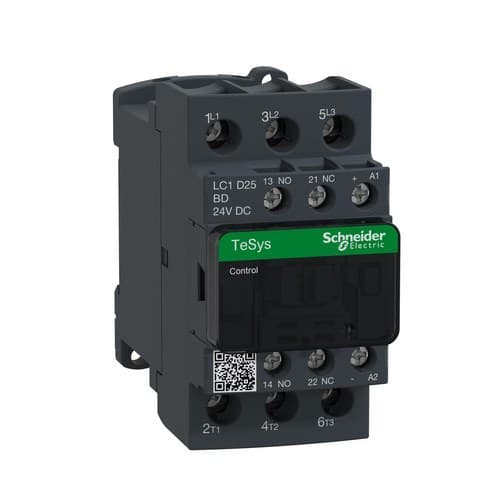
Information about Contactor 25A 1 NO/1 NC 24V DC-AR
The Schneider Electric LC1D25BD is a power contactor from the TeSys Deca range designed for motor control and resistive loads in electrical installations and automation systems. It features 3 normally open main poles (3 NO), a rated operational current of 25 A in AC-3 and AC-3e categories up to 440 V, and a 24 V DC control coil. It also includes, as standard, one normally open auxiliary contact and one normally closed auxiliary contact, making signaling, interlocking, and control functions easier.
For motor applications, the LC1D25BD can control three-phase motors up to 11 kW at 380-400 V. Its DC coil incorporates an integrated bidirectional surge suppressor, designed to limit transient overvoltages generated during switching operations. Power and control circuit connections are made using screw terminals, facilitating integration into professional electrical panels.
Main features of the Schneider Electric LC1D25BD
- Power contactor for motor control and resistive loads.
- Brand: Schneider Electric.
- Range: TeSys Deca.
- Reference: LC1D25BD.
- Number of main poles: 3P.
- Main contact composition: 3 NO.
- Rated operational current: 25 A in AC-3/AC-3e up to 440 V.
- Rated operational current: 40 A in AC-1 up to 440 V.
- Motor power: 11 kW at 380-400 V AC.
- Motor power: 11 kW at 415-440 V AC.
- Motor power: 5.5 kW at 220-230 V AC.
- Motor power: 15 kW at 500 V AC.
- Motor power: 15 kW at 660-690 V AC.
- Coil voltage: 24 V DC.
- Standard DC coil.
- Integrated bidirectional surge suppressor in the coil.
- Integrated auxiliary contacts: 1 NO + 1 NC.
- NC auxiliary contact certified as a mirror contact.
- Rated operational voltage of the power circuit: up to 690 V AC.
- Utilization categories: AC-1, AC-3, AC-3e and AC-4.
- Connection via screw terminals.
- Impulse withstand voltage Uimp: 6 kV.
- Overvoltage category III.
3-pole contactor for three-phase motors
The LC1D25BD has three normally open main contacts, intended to simultaneously connect and disconnect the three supply phases of a motor or other compatible three-phase load.
When the coil receives 24 V DC, the electromagnetic mechanism closes the three main poles. When coil power is removed, the contacts return to their rest position and the power circuit is interrupted.
25 A in AC-3 and AC-3e category
Schneider Electric specifies a rated operational current of 25 A up to 440 V in AC-3 and AC-3e categories. These categories are related to motor switching, especially squirrel-cage motors in starting, running, and disconnecting applications.
For non-inductive or slightly inductive loads in AC-1 category, the rated capacity increases to 40 A at temperatures up to 60 °C, within the conditions indicated by the manufacturer.
Utilization category Rated current AC-3 25 A up to 440 V AC-3e 25 A up to 440 V AC-1 40 A up to 440 VUp to 11 kW motor power at 400 V
In motor control applications, the permissible power depends on the supply voltage. For a typical three-phase 380-400 V network, the LC1D25BD can control motors up to 11 kW in AC-3 category.
Motor voltage AC-3 reference power 220-230 V AC 5.5 kW 380-400 V AC 11 kW 415-440 V AC 11 kW 500 V AC 15 kW 660-690 V AC 15 kWThe final selection of the contactor must be made considering the motor rated current, supply voltage, utilization category, switching frequency, and the actual environmental conditions of the installation.
24 V DC control coil
The LC1D25BD reference includes a standard 24 V DC coil. This allows direct integration into automation systems operating with 24 V DC, a common voltage in PLCs, industrial power supplies, relays, and control circuits.
Schneider Electric specifies a consumption of approximately 5.4 W at 20 °C both during pull-in and holding of the coil.
Integrated surge suppressor
The coil incorporates a bidirectional surge suppressor. This element limits transient overvoltages that may be generated when disconnecting an inductive load such as a contactor coil.
The integration of this suppression system is especially useful when the contactor is controlled by PLCs, electronic relays, or other automation devices sensitive to electrical transients.
1 NO + 1 NC auxiliary contacts
In addition to the three main power poles, the LC1D25BD has two integrated auxiliary contacts: 1 normally open and 1 normally closed.
These contacts can be used for electrical interlocking, contactor status signaling, feedback to a PLC, or integration with other control circuit devices.
The normally closed auxiliary contact is certified as a mirror contact, while the NO and NC contacts are mechanically linked according to the requirements established by the applicable standards.
Power circuit characteristics
Characteristic Value Number of poles 3P Main contacts 3 NO AC-3/AC-3e rated current 25 A AC-1 rated current 40 A Maximum AC operational voltage 690 V Power circuit frequency 25-400 Hz Rated insulation voltage Ui 690 V according to IEC 60947 Impulse withstand voltage Uimp 6 kV Overvoltage category IIIShort-time current withstand capacity
Schneider Electric specifies different short-time current withstand capacities for the power circuit. The LC1D25BD supports, among other values, 380 A for 1 second and 240 A for 10 seconds at 40 °C.
Duration Withstand current Icw 1 second 380 A 10 seconds 240 A 1 minute 120 A 10 minutes 50 AFuse coordination
For power circuit protection, Schneider Electric provides associated fuses of different ratings depending on the required coordination type.
- Up to 63 A gG for type 1 coordination at voltages up to 690 V.
- Up to 40 A gG for type 2 coordination at voltages up to 690 V.
- 10 A gG for the signaling circuit.
The final selection and coordination of protection devices must be carried out according to the electrical diagram, the available short-circuit current, and Schneider Electric's official coordination tables.
Screw terminals
The LC1D25BD uses screw terminals for both the power circuit and the control circuit. This solution is widely used in industrial panels for its ease of installation, maintenance, and replacement.
The power circuit accepts conductors of different cross-sections and configurations, including rigid and flexible conductors with or without ferrules, within the limits established by the manufacturer.
High durability
Schneider Electric specifies a mechanical durability of up to 30 million cycles for this contactor. In AC-3 category at 25 A and voltages up to 440 V, the declared electrical durability reaches approximately 1.65 million cycles.
Characteristic Value Mechanical durability 30 million cycles Electrical durability AC-3 1.65 million cycles at 25 A Electrical durability AC-3e 1.65 million cycles at 25 A Electrical durability AC-1 1.4 million cycles at 40 ARecommended applications
The Schneider Electric TeSys Deca LC1D25BD is especially suitable for electrical panels and automation systems where motor or load control is required using a 24 V DC control signal.
- Direct starting of three-phase motors.
- Pumps and booster sets.
- Fans and extractors.
- Compressors.
- HVAC and air conditioning systems.
- Conveyor belts.
- Industrial machinery.
- Pumping and water treatment systems.
- Automation panels with PLCs.
- Resistive load control.
Integration with the TeSys range
The LC1D25BD can be combined with different accessories and devices from the Schneider Electric TeSys family, including thermal overload relays, auxiliary contact blocks, and interlocking systems.
Its combination with a compatible TeSys LRD thermal overload relay makes it possible to form a direct motor starter in which the contactor performs the switching operations and the thermal relay provides protection against overloads and phase loss.
Standards and certifications
The TeSys Deca contactor is designed in accordance with the main international standards applicable to contactors and motor starters, including IEC 60947-4-1 and IEC 60947-5-1. The range also has international certifications for use in different markets and industrial applications.
Technical summary of the Schneider Electric LC1D25BD
Characteristic Specification Brand Schneider Electric Range TeSys Deca Reference LC1D25BD Type Power contactor Main poles 3P Main contacts 3 NO AC-3/AC-3e rated current 25 A AC-1 rated current 40 A Motor power at 380-400 V 11 kW Coil 24 V DC Auxiliary contacts 1 NO + 1 NC Surge suppressor Integrated Maximum AC operational voltage 690 V Insulation voltage Ui 690 V Impulse withstand voltage Uimp 6 kV Connection Screw terminals Mechanical durability 30 million cyclesThe Schneider Electric LC1D25BD combines 25 A switching capacity in AC-3/AC-3e, motor control up to 11 kW at 400 V, a 24 V DC coil with transient suppression, and 1 NO + 1 NC auxiliary contacts. Its integration into the TeSys Deca platform makes it a versatile solution for motor control panels, industrial automation, and HVAC applications.
