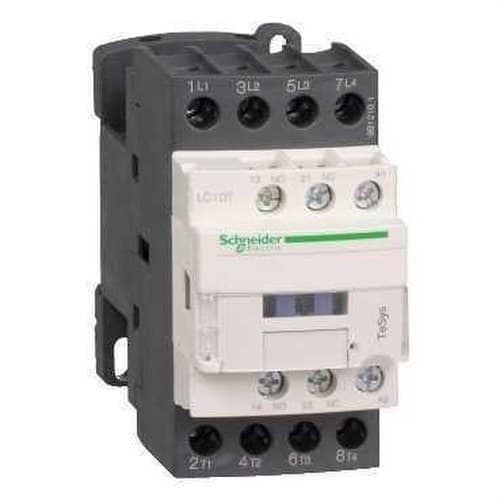
Information about Contactor 32A 1 NO/1 NC 230V 50-60HZ 4P
The Schneider Electric LC1DT32P7 is a power contactor from the TeSys Deca / TeSys D range, designed primarily for switching resistive loads. It features 4 poles with 4 normally open main contacts (4 NO), a rated operational current of 32 A in AC-1 category up to 440 V, and a control coil of 230 V AC at 50/60 Hz. It also includes two auxiliary contacts as standard, one normally open and one normally closed, for signaling, interlocking, and control functions.
Its compact 45 mm width allows installation on DIN rail or a mounting plate inside professional electrical panels. The LC1DT32P7 uses screw terminals for both power and control circuits, supports operational voltages up to 690 V AC in the main circuit, and offers high mechanical durability, making it suitable for installations that require reliable and repetitive switching of electrical loads.
Main features of the Schneider Electric LC1DT32P7
- Electromechanical power contactor.
- Brand: Schneider Electric.
- Range: TeSys Deca / TeSys D.
- Reference: LC1DT32P7.
- Number of main poles: 4P.
- Main contact configuration: 4 NO.
- Main application: resistive loads.
- Main utilization category: AC-1.
- Rated operational current: 32 A up to 440 V AC in AC-1.
- Maximum operational voltage of the power circuit: 690 V AC.
- Power circuit frequency: 25-400 Hz.
- Coil voltage: 230 V AC.
- Coil frequency: 50/60 Hz.
- Integrated auxiliary contacts: 1 NO + 1 NC.
- NC auxiliary contact with mirror contact function.
- Mechanically linked auxiliary contacts.
- Rated insulation voltage Ui: 690 V according to IEC.
- Impulse withstand voltage Uimp: 6 kV.
- Overvoltage category III.
- Mounting on DIN rail or plate.
- Screw terminal connection.
- Front protection rating: IP20.
4 normally open main poles
The LC1DT32P7 has four normally open main contacts. When the coil is not energized, all four poles remain open. When 230 V AC is applied to the coil, the electromagnetic mechanism simultaneously actuates the four main contacts and allows current to flow to the load.
This 4 NO configuration makes it possible to control four-wire circuits or switch several poles simultaneously using a single control signal.
The 1 NO + 1 NC commonly indicated in the commercial designation refer to the auxiliary contacts built into the contactor, and not to the four main power poles.
32 A in AC-1 category
Schneider Electric specifies for the LC1DT32P7 a rated operational current of 32 A at an ambient temperature of 60 °C and voltages up to 440 V AC in AC-1 category.
AC-1 category is mainly intended for non-inductive or slightly inductive loads, such as certain electric heating systems and other resistive loads.
Power circuit characteristic Value Rated operational current AC-1 32 A Voltage associated with 32 A Up to 440 V AC Reference temperature 60 °C Main contacts 4 NO Maximum AC operational voltage 690 V Power circuit frequency 25-400 Hz230 V AC 50/60 Hz coil
The P7 coil code corresponds to a control supply of 230 V AC at 50/60 Hz. This feature allows the contactor to be operated from control circuits working directly at this voltage.
The coil is AC and does not include an integrated surge suppression module. Schneider Electric specifies an approximate inrush consumption of 70 VA and a holding consumption of approximately 7 VA at 50 Hz and 7.5 VA at 60 Hz.
Coil characteristic Value Control voltage Uc 230 V AC Frequency 50/60 Hz Inrush power 70 VA Holding consumption at 50 Hz 7 VA Holding consumption at 60 Hz 7.5 VA Coil thermal dissipation 2-3 W Integrated suppressor No1 NO + 1 NC auxiliary contacts
In addition to its four power poles, the Schneider Electric LC1DT32P7 includes as standard one normally open auxiliary contact and one normally closed auxiliary contact.
These contacts can be used for interlocking, status signaling, feedback to automation systems, or coordination with other contactors and control devices.
Schneider Electric specifies that the NO and NC auxiliary contacts are mechanically linked in accordance with IEC 60947-5-1. The NC contact also serves as a mirror contact according to IEC 60947-4-1, a relevant feature in certain safety and monitoring architectures.
Electrical characteristics
Characteristic Specification Number of poles 4P Main contacts 4 NO Rated current AC-1 32 A Power circuit operational voltage Up to 690 V AC DC operational voltage Up to 300 V DC Coil 230 V AC 50/60 Hz Auxiliary contacts 1 NO + 1 NC Conventional thermal current of signaling circuit 10 A at 60 °C Rated insulation voltage Ui 690 V according to IEC Impulse withstand voltage Uimp 6 kV Overvoltage category IIIMaking and breaking capacity
For the main circuit, Schneider Electric specifies a rated making capacity of 300 A at 440 V and a rated breaking capacity also of 300 A at 440 V under the conditions defined by IEC 60947.
These characteristics describe the electromechanical capability of the contactor during switching operations and should not be confused with the breaking capacity of a circuit breaker under short-circuit conditions.
Short-time withstand current
The power circuit is designed to withstand different current levels for limited periods under the conditions established by Schneider Electric.
Duration Withstand current Icw 1 second 240 A 10 seconds 145 A 1 minute 84 A 10 minutes 40 AFuse protection
Schneider Electric specifies for the power circuit associated fuse protection of up to 50 A gG for type 1 coordination and up to 35 A gG for type 2 coordination, at voltages up to 690 V.
For the auxiliary or signaling circuit, 10 A gG fuses are specified. Final protection selection must be made following Schneider Electric coordination tables and the actual installation conditions.
Screw terminals
The LC1DT32P7 uses screw terminals for both the power circuit and the control circuit. This system facilitates installation and maintenance in professional electrical panels.
The main circuit accepts rigid conductors up to 16 mm², while the control circuit allows different combinations of rigid and flexible conductors depending on the number of connected wires and the use of terminals.
Schneider Electric specifies a tightening torque of 1.7 Nm for the power and control terminals.
DIN rail or plate mounting
The contactor can be installed on a DIN rail or directly on a mounting plate. This dual mounting option makes integration easier in modular panels as well as industrial enclosures and automation panels.
Its width of only 45 mm allows compact switching systems to be configured and the contactor to be combined with other TeSys family components.
Dimensions and weight
Characteristic Value Width 45 mm Height 91 mm Depth 99 mm Approximate net weight 0.425 kg Mounting DIN rail or plateHigh durability
The Schneider Electric LC1DT32P7 is designed for a high number of switching operations. The manufacturer specifies a mechanical durability of 15 million cycles.
In AC-1 category at 32 A and up to 440 V, the indicated electrical durability reaches approximately 1 million cycles.
Durability Value Mechanical 15 million cycles Electrical AC-1, 32 A 1 million cycles Maximum switching frequency 3600 cycles/h at 60 °COperating times
The electromagnetic mechanism provides fast switching times, suitable for automation and repetitive switching applications.
Operation Time Closing 12-22 ms Opening 4-19 msIP20 protection rating
The front face of the LC1DT32P7 has an IP20 protection rating according to IEC 60529. The contactor is intended to be installed inside a panel or enclosure that provides the appropriate level of protection for the environmental conditions of the installation.
Operating temperature
The contactor can operate at ambient temperatures between -40 and +60 °C without derating. Schneider Electric allows operation up to +70 °C when applying the performance reduction conditions specified by the manufacturer.
Environmental condition Value Operation without derating -40 to +60 °C Operation with derating Up to +70 °C Storage temperature -60 to +80 °C Operating altitude Up to 3000 m Pollution degree 3Recommended applications
Due to its four-pole configuration, AC-1 category, and 32 A rated current, the Schneider Electric LC1DT32P7 is especially suited for switching resistive loads and circuits that require simultaneous opening or closing of four poles.
- Electric heating systems.
- Heating resistor banks.
- Industrial heaters.
- HVAC and air conditioning equipment.
- Electrical automation panels.
- Switching four-pole circuits.
- Industrial and commercial installations.
- Systems controlled by PLCs, relays, or thermostats.
Compatibility with the TeSys range
The LC1DT32P7 is part of the Schneider Electric TeSys platform and can be combined with auxiliary contact blocks, signaling accessories, interlocks, and other compatible components to adapt the contactor to the needs of the control system.
For applications requiring protection against overloads, short circuits, or other electrical faults, the appropriate protection devices must be selected separately, since the contactor is a switching device and does not replace a circuit breaker or protective fuse.
Standards and certifications
The Schneider Electric LC1DT32P7 is developed in accordance with international standards applicable to electromechanical contactors, including IEC/EN 60947-4-1 and IEC/EN 60947-5-1.
The manufacturer documentation also includes certifications such as UL, CSA, CCC, and various approvals for industrial and marine applications.
Schneider Electric LC1DT32P7 technical summary
Characteristic Specification Brand Schneider Electric Range TeSys Deca / TeSys D Reference LC1DT32P7 Type Power contactor Number of poles 4P Main contacts 4 NO Main application Resistive loads Utilization category AC-1 Rated current 32 A up to 440 V AC Coil 230 V AC 50/60 Hz Auxiliary contacts 1 NO + 1 NC Maximum AC operational voltage 690 V Ui 690 V according to IEC Uimp 6 kV Connection Screw terminals Mounting DIN rail or plate Front protection rating IP20 Dimensions 45 x 91 x 99 mm Net weight 0.425 kg Mechanical durability 15 million cycles EAN 3389110244625The Schneider Electric LC1DT32P7 TeSys Deca combines four normally open main contacts, 32 A AC-1 capacity, a 230 V AC 50/60 Hz coil, and integrated 1 NO + 1 NC auxiliary contacts. Its compact format, high durability, and DIN rail or plate mounting option make it a reliable solution for switching resistive loads in professional electrical panels.
