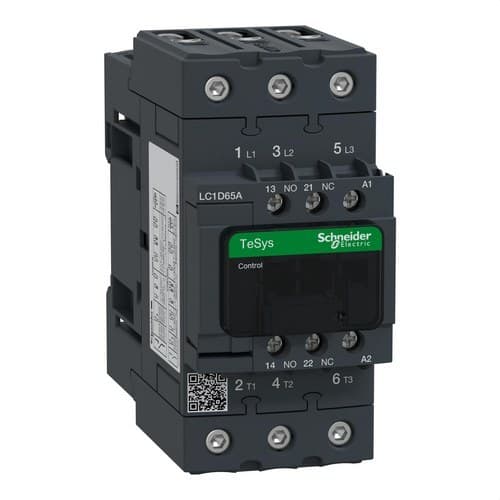
Information about Everlink Contactor 3P AC3 440V 65A 230V
The Schneider Electric TeSys Deca LC1D65AP7 contactor is a 3-pole power contactor with 3 normally open main contacts, designed for switching motors and electrical loads in industrial and professional installations. It offers a rated operational current of 65 A in AC-3 and AC-3e categories up to 440 V, can control three-phase motors up to 30 kW at 380-400 V, and uses a 230 V AC control coil at 50/60 Hz. It incorporates EverLink BTR power connections and comes standard with 1 NO auxiliary contact + 1 NC auxiliary contact.
The LC1D65AP7 reference belongs to Schneider Electric's TeSys Deca range and is intended for motor control, machinery, automation, and HVAC systems. Its EverLink connection technology is designed to provide a robust tightening and simplify the wiring of power conductors, while its DIN rail or panel mounting allows easy integration into professional electrical panels.
65 A three-pole contactor in AC-3
The LC1D65AP7 features 3 normally open main poles that simultaneously connect and disconnect the three phases of the power circuit.
- Number of poles: 3P.
- Main contacts: 3 NO.
- AC-3 current: 65 A up to 440 V.
- AC-3e current: 65 A up to 440 V.
- AC-1 current: 80 A up to 440 V.
The 65 A rating applies to AC-3/AC-3e applications, mainly intended for starting and stopping squirrel-cage motors. For resistive or slightly inductive loads in AC-1 category, the permissible current increases to 80 A under the conditions established by Schneider Electric.
Motor up to 30 kW at 400 V
In motor control applications, the permissible power depends on the supply voltage.
- 220-230 V AC: 18.5 kW.
- 380-400 V AC: 30 kW.
- 500 V AC: 37 kW.
- 660-690 V AC: 37 kW.
Therefore, in a typical 400 V three-phase installation, the Schneider Electric LC1D65AP7 can be used to control motors up to 30 kW in AC-3/AC-3e category, provided the motor's actual current, starting method, and duty cycle are compatible.
230 V AC 50/60 Hz control coil
The P7 suffix identifies a 230 V AC 50/60 Hz control coil.
This coil allows the contactor to be operated from 230 V AC control circuits using compatible devices such as pushbuttons, relays, pressure switches, thermostats, PLCs with the appropriate interface, or industrial control systems.
Schneider Electric specifies the following approximate operating voltage limits:
- At 50 Hz: 0.8-1.1 × Uc.
- At 60 Hz: 0.85-1.1 × Uc.
- Drop-out voltage: approximately 0.3-0.6 × Uc.
Standard coil without integrated suppressor
The LC1D65AP7 coil is a standard AC type and does not include an integrated surge suppressor module.
When the circuit design requires limiting transients generated during coil de-energization, compatible suppression modules from the TeSys range can be used.
Control circuit consumption
The coil consumption is higher during the initial closing instant and decreases once the contactor is magnetically latched.
- Inrush power at 50 Hz: approximately 160 VA.
- Inrush power at 60 Hz: approximately 140 VA.
- Holding consumption at 50 Hz: approximately 15 VA.
- Holding consumption at 60 Hz: approximately 13 VA.
- Thermal dissipation: approximately 4-5 W.
These values should be taken into account when sizing transformers, auxiliary power supplies, and control circuit switching elements.
EverLink BTR power connections
One of the distinctive features of the LC1D65AP7 is the use of EverLink BTR screw connectors in the power circuit.
The EverLink system is designed to provide a robust and stable conductor connection, facilitating tightening with a hexagonal screw and reducing issues associated with an incorrectly made connection.
In the power circuit it supports configurations such as:
- 1 flexible conductor: up to 35 mm².
- 2 flexible conductors: up to 25 mm² per conductor.
- Tightening torque for 1-25 mm² conductors: 5 Nm using a hexagonal screw.
- Tightening torque for 25-35 mm² conductors: 8 Nm using a hexagonal screw.
The exact tightening torque must be respected according to the cross-section, number of conductors, and tool used.
1 NO + 1 NC integrated auxiliary contact
In addition to the three main power contacts, the contactor includes as standard:
- 1 normally open auxiliary contact.
- 1 normally closed auxiliary contact.
Therefore, its configuration is:
- Main contacts: 3 NO.
- Auxiliary contacts: 1 NO + 1 NC.
The auxiliary contacts can be used for self-holding, status indication, feedback to a PLC, automation sequences, or electrical interlocking.
Mechanically linked auxiliary contacts
Schneider Electric specifies that the 1 NO + 1 NC auxiliary contacts are mechanically linked in accordance with IEC 60947-5-1.
The NC auxiliary contact also features a mirror contact characteristic in accordance with IEC 60947-4-1, a useful feature for certain monitoring functions when the overall system design is prepared for it.
80 A for AC-1 loads
In AC-1 category, intended for non-inductive or slightly inductive loads, the LC1D65AP7 supports up to 80 A at voltages up to 440 V and temperatures below 60 °C.
The 80 A AC-1 and 65 A AC-3 values should not be compared directly, as they correspond to different operating conditions.
AC-1, AC-3, AC-3e and AC-4 categories
The Schneider Electric TeSys Deca LC1D65AP7 is specified for different utilization categories:
- AC-1: resistive or slightly inductive loads.
- AC-3: conventional starting and stopping of squirrel-cage motors.
- AC-3e: updated category for certain motor applications.
- AC-4: demanding motor switching such as jogging, plugging, or inching.
In AC-4 at 400 V, Schneider Electric specifies a motor power of approximately 11 kW.
Power circuit up to 690 V AC
The main power circuit characteristics include:
- Maximum AC operating voltage: 690 V.
- Frequency: 25-400 Hz.
- Maximum DC operating voltage: 300 V, depending on configuration.
- Rated insulation voltage Ui: 690 V according to IEC.
- Rated impulse withstand voltage Uimp: 6 kV.
- Overvoltage category: III.
- Pollution degree: 3.
High making and breaking capacity
Schneider Electric specifies for the main circuit:
- Rated making capacity: 1,000 A at 440 V.
- Rated breaking capacity: 1,000 A at 440 V.
These figures represent the contactor's switching capability according to IEC 60947 and do not correspond to the short-circuit breaking capacity of a circuit breaker.
Short-time withstand current
The main circuit has short-time withstand values such as:
- 900 A for 1 second.
- 640 A for 10 seconds.
- 260 A for 1 minute.
- 110 A for 10 minutes.
These parameters are important when studying coordination of the contactor with fuses, motor protection switches, or upstream circuit breakers.
External short-circuit protection
The LC1D65AP7 is a switching device and does not include its own short-circuit protection.
Schneider Electric provides, among other coordination configurations, gG fuses up to 125 A for the main circuit, depending on the type of coordination and the characteristics of the assembly.
Final protection must be calculated according to the motor, wiring, available short-circuit current, and installation coordination requirements.
High electrical durability
The specified electrical durability reaches approximately:
- 1.45 million cycles: at 65 A in AC-3 up to 440 V.
- 1.45 million cycles: at 65 A in AC-3e up to 440 V.
- 1.4 million cycles: at 80 A in AC-1 up to 440 V.
Actual service life will depend on the load, switching frequency, temperature, and operating conditions.
Mechanical durability of 6 million cycles
The Schneider Electric LC1D65AP7 offers a mechanical durability of up to 6 million cycles, suitable for automation applications subject to repetitive switching.
Schneider Electric also specifies a maximum operating frequency of up to 3,600 cycles per hour at 60 °C, within the product's rated conditions.
Opening and closing times
The electromagnetic mechanism has the following approximate times:
- Closing time: 12-26 ms.
- Opening time: 4-19 ms.
These times facilitate integration into automation and industrial sequences that require a fast and repeatable response.
DIN rail or panel mounting
The contactor can be installed by:
- DIN rail.
- Direct panel mounting.
This makes it easy to integrate into both compact machine panels and larger industrial enclosures.
Dimensions of the Schneider Electric LC1D65AP7
- Width: 55 mm.
- Height: 122 mm.
- Depth: 120 mm.
- Weight: approximately 0.86 kg.
Despite its 65 A AC-3 rating, it maintains a relatively compact form factor to facilitate installation in automation and power panels.
IP20 protection rating
The front part of the contactor has an IP20 protection rating in accordance with IEC 60529.
The equipment is intended to be mounted inside an enclosure that provides the required degree of protection against the environment and accidental access to live parts.
Environmental conditions
The LC1D65AP7 is designed to operate within a wide range of conditions:
- Ambient temperature: -40 to 60 °C.
- Operation from 60 to 70 °C: possible with derating.
- Storage temperature: -60 to 80 °C.
- Operating altitude: up to 3,000 m.
- Protection treatment: TH according to IEC 60068-2-30.
Resistance to vibration and shock
The contactor is designed to withstand the typical stresses of industrial installations:
- Vibrations with contactor open: 2 gn between 5 and 300 Hz.
- Vibrations with contactor closed: 4 gn between 5 and 300 Hz.
- Shocks with contactor closed: 15 gn for 11 ms.
- Shocks with contactor open: 10 gn for 11 ms.
Applications of the Schneider Electric LC1D65AP7
Thanks to its 65 A AC-3 rating and ability to control 30 kW motors at 400 V, this reference can be used in many professional and industrial installations:
- Three-phase motors.
- Pumps.
- Compressors.
- Industrial fans.
- HVAC equipment.
- Production machinery.
- Conveyor systems.
- Automation panels.
- Direct-on-line motor starters.
- Resistive loads up to 80 A AC-1.
Compatibility with TeSys accessories
The LC1D65AP7 can be integrated with different compatible accessories from the TeSys platform, allowing complete control and protection solutions to be built.
These may include:
- Overload relays.
- Additional auxiliary blocks.
- Timers.
- Surge suppression modules.
- Interlocks.
- Connection accessories.
- Compatible motor protection devices.
Compatibility should always be verified using the specific accessory reference and the manufacturer's coordination tables.
Technical characteristics of the Schneider Electric LC1D65AP7
- Brand: Schneider Electric.
- Reference: LC1D65AP7.
- Range: TeSys Deca.
- Short name: LC1D.
- Type: power contactor.
- Application: motor and resistive load control.
- Number of poles: 3P.
- Main contacts: 3 NO.
- Auxiliary contacts: 1 NO + 1 NC.
- AC-3 current: 65 A up to 440 V.
- AC-3e current: 65 A up to 440 V.
- AC-1 current: 80 A up to 440 V.
- AC-3 power at 220-230 V: 18.5 kW.
- AC-3 power at 380-400 V: 30 kW.
- AC-3 power at 500 V: 37 kW.
- AC-3 power at 660-690 V: 37 kW.
- AC-4 power at 400 V: 11 kW.
- Coil voltage: 230 V AC.
- Coil frequency: 50/60 Hz.
- Coil type: standard AC.
- Integrated suppressor: no.
- Power connection: EverLink BTR.
- Maximum power circuit voltage: 690 V AC.
- Maximum DC voltage: 300 V DC depending on configuration.
- Insulation voltage Ui: 690 V according to IEC.
- Rated impulse withstand voltage Uimp: 6 kV.
- Utilization categories: AC-1, AC-3, AC-3e and AC-4.
- Making capacity: 1,000 A at 440 V.
- Breaking capacity: 1,000 A at 440 V.
- Conventional thermal current Ith: 80 A at 60 °C for the power circuit.
- Mounting: DIN rail or panel.
- Width: 55 mm.
- Height: 122 mm.
- Depth: 120 mm.
- Weight: approximately 0.86 kg.
- Mechanical durability: up to 6 million cycles.
- Electrical durability AC-3: approximately 1.45 million cycles.
- Maximum switching frequency: 3,600 cycles/h.
- Closing time: 12-26 ms.
- Opening time: 4-19 ms.
- Inrush consumption: 160 VA at 50 Hz / 140 VA at 60 Hz.
- Holding consumption: 15 VA at 50 Hz / 13 VA at 60 Hz.
- Coil dissipation: approximately 4-5 W.
- Front protection rating: IP20.
- Operating temperature: -40 to 60 °C; up to 70 °C with derating.
- Storage temperature: -60 to 80 °C.
- Operating altitude: up to 3,000 m.
- EAN: 3389119409025.
- Main standards: IEC/EN 60947-4-1 and IEC/EN 60947-5-1.
EverLink contactor for motors up to 30 kW at 400 V
The Schneider Electric TeSys Deca LC1D65AP7 combines a 65 A AC-3/AC-3e rating, motor control capability up to 30 kW at 400 V, and a 230 V AC control coil. Its EverLink BTR connection system is specially designed to provide robust power connections in professional applications.
The integrated 1 NO + 1 NC auxiliary contacts, the option for DIN rail or panel mounting, the different utilization categories, and compatibility with TeSys accessories make it suitable for motor starters, automation panels, HVAC systems, and industrial machinery.
Important: the LC1D65AP7 is a switching and control device. It does not itself provide overload or short-circuit protection. In motor applications, it must be installed together with a motor protection switch, overload relay, fuses, or a properly rated circuit breaker coordinated with the characteristics of the motor and installation.
