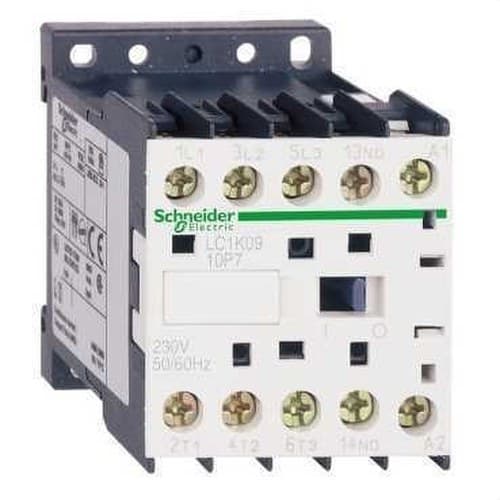
Information about Tripolar K Mini Contactor 9A 230V 50-60HZ
The Schneider Electric TeSys K LC1K0910P7 mini contactor is a compact 3-pole contactor with 3 normally open main contacts, designed for motor control and resistive loads in electrical panels and automation systems. It offers a rated current of 9 A in AC-3/AC-3e category up to 440 V, can control motors up to 4 kW at 380-415 V, and includes a 230 V AC control coil at 50/60 Hz. It also features 1 instantaneous NO auxiliary contact, screw terminals, and an especially compact format of just 45 mm width.
The LC1K0910P7 reference belongs to Schneider Electric's TeSys K range, developed to provide power switching functions in limited spaces. It can be installed on DIN rail or by panel mounting and is especially suitable for machinery, pumps, fans, HVAC, conveyors, and other equipment where frequent switching is required via a 230 V AC control circuit.
9 A three-pole mini contactor
The LC1K0910P7 has 3 normally open main poles. When the coil is energized, the three poles close simultaneously and supply the load; when the coil is de-energized, they return to the open position.
- Number of poles: 3P.
- Main contacts: 3 NO.
- Rated current AC-3/AC-3e: 9 A up to 440 V.
- Applications: motor control and resistive loads.
Up to 4 kW motor at 400 V
In AC-3 category, Schneider Electric specifies different motor power ratings depending on the supply voltage:
- 220-230 V AC: 2.2 kW.
- 380-415 V AC: 4 kW.
- 440 V AC: 4 kW.
- 480 V AC: 4 kW.
- 500-600 V AC: 4 kW.
- 660-690 V AC: 4 kW.
On a typical 400 V three-phase network, the mini contactor can therefore control motors up to 4 kW, provided the motor rated current and starting conditions are compatible with the device's 9 A AC-3 rating.
230 V AC 50/60 Hz coil
The P7 suffix identifies this version with a 230 V AC control coil for 50/60 Hz.
The coil allows the contactor to be controlled from devices such as:
- Pushbuttons.
- Control relays.
- Thermostats.
- Pressure switches.
- Limit switches.
- PLCs via an appropriate output or interface.
- Automation and control systems.
Schneider Electric specifies an approximate coil operating range of 0.8 to 1.15 × Uc at temperatures up to 50 °C and a drop-out range of 0.2 to 0.75 × Uc.
Coil consumption
The control circuit has low consumption thanks to the mini contactor's small size:
- Inrush power: approximately 30 VA at 20 °C.
- Holding power: approximately 4.5 VA at 20 °C.
- Thermal dissipation: approximately 1.3 W.
These values should be considered when sizing control transformers, relay outputs, and other elements used to energize the coil.
1 integrated NO auxiliary contact
In addition to the three main poles, the LC1K0910P7 includes 1 normally open instantaneous auxiliary contact as standard.
The complete configuration is:
- Main contacts: 3 NO.
- Auxiliary contacts: 1 NO.
- Integrated NC auxiliary contacts: none.
The auxiliary contact can be used for functions such as:
- Self-holding.
- Run indication.
- Feedback to a PLC.
- Automation sequences.
- Electrical interlocking.
Up to 20 A for AC-1 loads
In addition to motor control, the TeSys K LC1K0910P7 can switch resistive or slightly inductive loads.
Schneider Electric specifies an operating current of up to 20 A in AC-1 category at voltages up to 440 V and temperatures up to 50 °C.
At 690 V AC, current documentation indicates 16 A in AC-1 within the manufacturer's specified conditions.
It is important not to confuse these values with the 9 A AC-3 rating: AC-1 and AC-3 correspond to different load types and switching requirements.
Utilization categories AC-1, AC-3, AC-3e and AC-4
The mini contactor can operate in different utilization categories depending on the load:
- AC-1: resistive or slightly inductive loads.
- AC-3: normal starting and stopping of squirrel-cage motors.
- AC-3e: updated category for certain motor control applications.
- AC-4: motor applications subject to more demanding switching.
In AC-4 at 400 V, specialized technical distributors specify approximately 6 A and 2.2 kW.
Making and breaking capacity
According to IEC 60947, Schneider Electric specifies a rated making capacity of 110 A AC for the power circuit.
The indicated breaking capacity varies with voltage:
- 220-230 V: 110 A.
- 380-400 V: 110 A.
- 415 V: 110 A.
- 440 V: 110 A.
- 500 V: 80 A.
- 660-690 V: 70 A.
These values refer to the contactor switching capacity and should not be confused with the short-circuit breaking capacity of a circuit breaker.
Required external protection
The LC1K0910P7 is a switching device and does not include built-in protection against overloads or short circuits.
Schneider Electric includes, among the documented associated protections:
- 25 A aM fuse: power circuit.
- 25 A gG fuse: power circuit up to 440 V.
- 10 A gG fuse: signaling circuit.
Final protection must be selected according to the load, wiring, available short-circuit current, and the manufacturer's coordination tables.
Screw connection terminals
The Schneider Electric LC1K0910P7 uses screw terminals for both the main circuit and auxiliary connections.
Depending on the conductor type and the number of wires connected, it accepts cross-sections of up to approximately 4 mm².
This solution provides a compact and conventional connection, especially suitable for automation panels and machinery.
DIN rail or panel mounting
The TeSys K design allows the mini contactor to be installed by:
- DIN rail mounting.
- Screw fixing on a panel or plate.
This dual mounting option makes it easy to integrate into both small panels and machine control cabinets.
Very compact dimensions
One of the main advantages of the TeSys K family is its reduced size:
- Width: 45 mm.
- Height: 58 mm.
- Depth: 57 mm.
- Weight: approximately 0.18 kg.
These dimensions make it possible to have a 9 A three-phase contactor with an integrated auxiliary contact while taking up very little space inside the panel.
High switching frequency
Schneider Electric specifies a maximum operating frequency of up to 3,600 cycles per hour within the documented rated conditions.
Approximate operating times are:
- Energization and NO contact closing: 10-20 ms.
- De-energization and NO contact opening: 10-20 ms.
These performance characteristics make the mini contactor suitable for many repetitive automation applications.
Mechanical and electrical durability
The TeSys K range is designed to provide a long service life:
- Mechanical durability: approximately 10 million cycles.
- Electrical durability: approximately 1.3 million cycles at 9 A in AC-3/AC-3e up to 440 V.
Actual electrical life depends on voltage, current, utilization category, and switching frequency.
Dielectric characteristics
The main insulation characteristics include:
- Rated insulation voltage Ui: 690 V.
- Rated impulse withstand voltage Uimp: 6 kV.
- Overvoltage category: III.
IP20 protection rating
The front and protected terminals of the mini contactor offer an IP20 protection rating under the corresponding mounting conditions.
The device is designed to be installed inside an enclosure or cabinet that provides the protection level required by the operating environment.
Environmental conditions
Specified operating conditions include:
- Minimum operating temperature: -25 °C.
- Maximum reference temperature for main performance: 50 °C.
- Operating altitude without temperature derating: up to 2,000 m.
- Vibration resistance with contactor open: 2 gn between 5 and 300 Hz.
- Vibration resistance with contactor closed: 4 gn between 5 and 300 Hz.
Applications of the Schneider Electric LC1K0910P7
Thanks to its compact size, 230 V AC coil, and ability to control motors up to 4 kW at 400 V, the mini contactor can be used in many pieces of equipment and panels:
- Pumps.
- Fans.
- Small compressors.
- HVAC systems.
- Conveyor belts.
- Compact machinery.
- Material handling equipment.
- Automation panels.
- Direct-on-line motor starters.
- Electric heating and other compatible resistive loads.
Compatible with TeSys K accessories
The LC1K0910P7 can be complemented with different TeSys K platform accessories to expand its functions.
These include:
- LA1K auxiliary contact blocks.
- Compatible time-delay auxiliary blocks.
- LR2K thermal overload relays.
- Connection accessories.
- Compatible mounting and interlocking elements.
The reference for each accessory should be checked in Schneider Electric's compatibility tables.
Technical characteristics of the Schneider Electric LC1K0910P7
- Brand: Schneider Electric.
- Reference: LC1K0910P7.
- Range: TeSys.
- Family: TeSys K.
- Type: power mini contactor.
- Application: motor and resistive load control.
- Number of poles: 3P.
- Main contacts: 3 NO.
- Integrated auxiliary contact: 1 instantaneous NO.
- AC-3/AC-3e current: 9 A up to 440 V.
- AC-1 current: up to 20 A at ≤440 V and 50 °C.
- AC-1 current at 690 V: up to 16 A in the specified conditions.
- Motor power at 220-230 V: 2.2 kW.
- Motor power at 380-415 V: 4 kW.
- Motor power at 440 V: 4 kW.
- Coil voltage: 230 V AC.
- Coil frequency: 50/60 Hz.
- Coil inrush power: approximately 30 VA.
- Holding power: approximately 4.5 VA.
- Coil dissipation: approximately 1.3 W.
- Making capacity: 110 A AC.
- Rated insulation voltage Ui: 690 V.
- Rated impulse withstand voltage Uimp: 6 kV.
- Overvoltage category: III.
- Terminals: screw terminals.
- Mounting: DIN rail or panel.
- Width: 45 mm.
- Height: 58 mm.
- Depth: 57 mm.
- Weight: approximately 0.18 kg.
- Protection rating: IP20.
- Maximum switching frequency: up to 3,600 cycles/h.
- Closing time: 10-20 ms.
- Opening time: 10-20 ms.
- Mechanical durability: approximately 10 million cycles.
- Electrical durability AC-3/AC-3e: approximately 1.3 million cycles.
- Minimum operating temperature: -25 °C.
- Altitude without temperature derating: up to 2,000 m.
- Main standard: IEC/EN 60947-4-1.
- EAN: 3389110364521.
Compact mini contactor for motors up to 4 kW
The Schneider Electric TeSys K LC1K0910P7 offers 9 A in AC-3/AC-3e category and the ability to control motors up to 4 kW at 400 V in a body measuring just 45 x 58 x 57 mm. Its 230 V AC 50/60 Hz coil makes it easy to integrate into conventional control circuits, and the built-in NO auxiliary contact allows latching or signaling functions without initially adding an external auxiliary block.
The screw terminals, DIN rail or panel mounting options, high switching frequency, and compatibility with TeSys K accessories make this reference especially suitable for compact machinery, HVAC, and automation panels.
Important: the LC1K0910P7 is a switching and control device. It does not protect the motor or circuit by itself against overloads and short circuits. It must be combined with a motor protection circuit breaker, thermal overload relay, fuses, or a properly sized circuit breaker coordinated with the load and installation characteristics.
