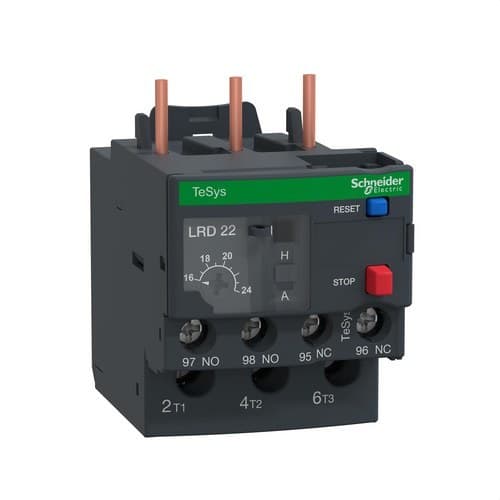
Information about Thermal Relay 17-25A
The Schneider Electric TeSys LRD22 thermal overload relay is a differential overload relay designed for the protection of three-phase electric motors. It features a thermal adjustment range of 16 to 24 A and a trip class 10A in accordance with IEC 60947-4-1, allowing the protection to be adapted to the motor’s rated current and disconnecting it when it detects a prolonged overload or certain phase loss and phase imbalance conditions.
Part of the TeSys LRD / TeSys Deca range, the LRD22 is specially designed to be directly mounted with Schneider Electric TeSys D contactors LC1D25, LC1D32 and LC1D38. This combination makes it possible to create compact motor starters with switching and protection functions, reducing wiring and the space required inside the electrical panel.
Adjustable thermal protection from 16 to 24 A
The front of the relay includes a selector that allows the trip current to be set within the 16 to 24 A range. The setting must be made according to the rated current shown on the motor nameplate and the actual operating conditions of the installation.
When the motor operates for a certain time above the selected current, the relay’s thermal elements cause tripping and act on the contactor control circuit. In this way, the motor supply is interrupted before a prolonged overload can cause excessive heating and damage to its windings.
Schneider Electric specifies a trip threshold of 1.14 ±0.06 times the set current Ir, in accordance with IEC 60947-4-1.
Trip class 10A
The TeSys LRD22 belongs to trip class 10A. This class is especially suited to motors with normal starting conditions and makes it possible to distinguish the current peaks typical of startup from a real sustained overload situation.
Correct selection of the class and adjustment range is essential to achieve proper motor protection without causing unnecessary disconnections during starting.
Protection against phase loss and phase imbalance
The LRD22 is a differential thermal relay, so in addition to monitoring overall motor overload it can also react to certain imbalances between phases and to phase loss.
Schneider Electric specifies phase-loss sensitivity with tripping when two phases reach approximately 130% of the set current Ir while the third remains at zero. This function is especially important in three-phase motors, since operating with one phase missing can cause a rapid temperature rise and damage the motor.
For three-phase motors up to 11 kW at 400 V
Within Schneider Electric’s recommended associations, the LRD22 relay can be used to protect three-phase motors up to approximately 11 kW at 400 V, provided that the motor’s actual rated current falls within the 16 to 24 A adjustment range.
The final selection should always be made based on the current indicated by the motor manufacturer, and not solely on its rated power.
1 NO + 1 NC auxiliary contacts
The relay comes standard with two signaling auxiliary contacts: 1 normally open and 1 normally closed. These contacts change state when thermal tripping occurs and allow intervention on the control circuit or the generation of an alarm signal.
The normally closed contact can be used to open the contactor coil circuit and stop the motor, while the normally open contact can be used to indicate the fault via an indicator light, relay, PLC input or another monitoring system.
The conventional thermal current of the signaling circuit is 5 A. Schneider Electric specifies capacities of up to 1.5 A at 240 V AC in AC-15 category and 0.1 A at 250 V DC in DC-13 category.
Manual or automatic reset
The Schneider Electric LRD22 allows selection between manual reset and automatic reset. In manual mode, after the cause of the trip has been resolved, the RESET button must be pressed before the installation can be restarted.
In automatic mode, the relay can return to its state once the thermal elements have cooled and conditions are again correct. The choice between both modes should be made taking into account the machine characteristics and the safety requirements of the installation.
STOP, RESET and TEST controls
The front of the relay includes different elements to facilitate commissioning, checking and maintenance:
- STOP button: allows manual operation of the control circuit.
- RESET button: allows the relay to be reset after a trip.
- Manual/automatic selector: defines the reset mode.
- TEST function: allows a trip to be simulated and the operation of the associated circuit to be checked.
- Trip indicator: makes it easy to visually identify the relay status.
The settings are protected by a transparent cover that can be sealed, helping prevent accidental or unauthorized changes to the selected current.
Direct mounting under TeSys D contactors
One of the main advantages of the LRD22 is its ability to be directly mounted under compatible Schneider Electric TeSys D contactors. The manufacturer indicates direct association with:
- LC1D25.
- LC1D32.
- LC1D38.
This arrangement creates a compact contactor-thermal relay assembly, reduces the number of connections required and simplifies the assembly of direct starters, reversing starters and other motor control configurations.
Possibility of independent mounting
When the installation does not require the relay to be placed directly under the contactor, the LRD22 can also be mounted independently on a DIN rail or plate using the Schneider Electric terminal block LAD7B106 or other compatible specific accessories.
This option provides greater flexibility when designing or refurbishing electrical panels where the physical layout of the devices does not allow direct coupling.
Operating voltage up to 690 V AC
The relay power circuit is designed to operate with a rated operational voltage of up to 690 V AC and mains frequencies between 0 and 400 Hz.
The rated insulation voltage Ui also reaches 690 V in accordance with IEC 60947-4-1, while the impulse withstand voltage Uimp is 6 kV.
Screw terminals for power and control circuits
The LRD22 uses screw terminal connections, ensuring a secure connection for both the power circuit and the auxiliary contacts.
For the power circuit it accepts:
- Flexible conductors without ferrule: from 1.5 to 10 mm².
- Flexible conductors with ferrule: from 1 to 6 mm².
- Rigid conductors: from 1.5 to 10 mm².
- Tightening torque: 2.5 Nm.
For the control circuit it accepts up to two conductors from 1 to 2.5 mm², depending on the cable type used, with a tightening torque of approximately 1.7 Nm.
Temperature compensation
The operation of thermal relays can be affected by ambient temperature. To maintain stable tripping behavior, the LRD22 incorporates temperature compensation between -20 and 60 °C.
Schneider Electric also specifies an operating range without derating between -20 and 60 °C and a storage range from -60 to 70 °C.
Compact design for electrical panels
The thermal relay has reduced dimensions that make installation easier when combined with TeSys D contactors:
- Width: 45 mm.
- Height: 66 mm.
- Depth: 70 mm.
- Net weight: approximately 0.124 kg.
Its 45 mm width makes it possible to obtain a compact and uniform assembly when installed directly under compatible contactors.
Technical characteristics of the Schneider Electric LRD22
- Brand: Schneider Electric.
- Reference: LRD22.
- Range: TeSys / TeSys Deca.
- Product: TeSys LRD.
- Type: differential thermal overload relay.
- Application: motor protection.
- Thermal adjustment current range: 16-24 A.
- Trip class: 10A according to IEC 60947-4-1.
- Trip threshold: 1.14 ±0.06 x Ir.
- Phase-loss sensitivity: yes.
- Phase-loss threshold: 130% of Ir in two phases with the third at 0.
- Auxiliary contacts: 1 NO + 1 NC.
- Conventional thermal current of signaling circuit: 5 A.
- Rated operational voltage: up to 690 V AC.
- Frequency: 0-400 Hz.
- Rated insulation voltage Ui: 690 V.
- Impulse withstand voltage Uimp: 6 kV.
- Direct compatibility: LC1D25, LC1D32 and LC1D38.
- Mounting: directly under contactor.
- Independent mounting: DIN rail or plate using compatible accessory.
- Accessory for independent mounting: LAD7B106.
- Connection type: screw terminals.
- Reset: manual or automatic.
- STOP button: yes.
- RESET button: yes.
- TEST function: yes.
- Trip indicator: yes.
- Temperature compensation: -20 to 60 °C.
- Operating temperature: -20 to 60 °C.
- Storage temperature: -60 to 70 °C.
- Degree of protection: IP20.
- Width: 45 mm.
- Height: 66 mm.
- Depth: 70 mm.
- Weight: approximately 0.124 kg.
- Flame resistance: V1 according to UL 94.
- Main standards: IEC/EN 60947-4-1 and IEC/EN 60947-5-1.
- EAN: 3389110346848.
Thermal relay for TeSys motor starters
The Schneider Electric LRD22 is a compact solution for protecting three-phase motors against overloads, phase loss and current imbalances. Its 16 to 24 A adjustment allows protection to be adapted to different motors within this range, and its 10A trip class is suitable for applications with conventional starting times.
The combination of differential thermal protection, 1 NO + 1 NC auxiliary contacts, manual or automatic reset, test function and direct mounting under LC1D25, LC1D32 and LC1D38 contactors makes it easy to create starting and protection systems for pumps, fans, compressors, conveyor belts and other machines driven by electric motors.
The LRD22 protects against overloads and phase loss, but does not replace short-circuit protection. The circuit must be completed with fuses, circuit breaker or motor protection circuit breaker correctly sized according to the characteristics of the motor and the installation.
