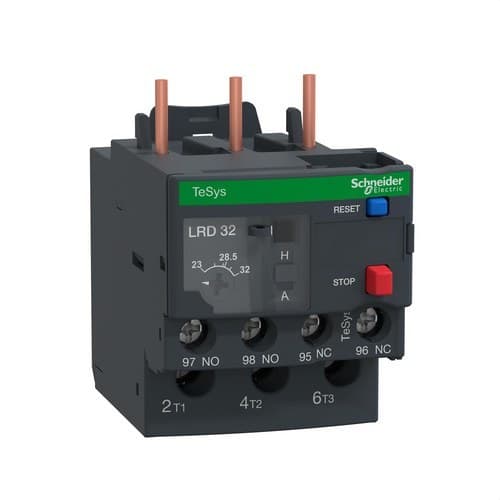
Information about Thermal Relay 23-32A
The Schneider Electric TeSys LRD32 thermal overload relay is a motor protection device designed to detect prolonged overloads and phase failure or phase imbalance. It features a thermal adjustment range of 23 to 32 A and a 10A trip class in accordance with IEC 60947-4-1, allowing the protection to be matched to the rated current of the installed motor.
The LRD32 belongs to Schneider Electric’s TeSys LRD and TeSys Deca ranges and is specifically designed to work with TeSys D contactors. It can be mounted directly under LC1D25, LC1D32 and LC1D38 contactors, forming a compact motor starting and protection assembly. It also supports independent mounting on DIN rail or panel using the corresponding specific accessories.
Adjustable thermal protection from 23 to 32 A
The front of the relay includes a selector that allows the protection current to be set within the 23 to 32 A range. In this way, the device can be calibrated according to the rated current shown on the motor nameplate.
When the current flowing through the motor remains above the set value for a certain period, the relay operates on the contactor control circuit to disconnect the motor supply and prevent damage caused by sustained overload.
The trip threshold specified by Schneider Electric is 1.14 ±0.06 times the set current Ir, in accordance with IEC 60947-4-1.
10A trip class
The Schneider Electric LRD32 features a 10A trip class. This class is widely used in applications with motors that have normal starting times and helps protect them against overloads without causing unnecessary tripping during a properly sized start-up.
The selection of the relay and its setting must take into account the motor rated current, starting conditions, ambient temperature and the specific characteristics of the installation.
Phase loss and phase imbalance detection
The LRD32 is a differential thermal overload relay, so in addition to responding to general overload it is sensitive to phase imbalance or phase loss conditions.
Schneider Electric specifies phase-failure tripping when two phases reach approximately 130% of the set current while the third phase carries no current. This function helps protect three-phase motors against a particularly harmful condition, since loss of one phase can cause a significant increase in current and temperature in the remaining windings.
1 NO + 1 NC auxiliary contacts
The relay includes two auxiliary contacts as standard, 1 normally open and 1 normally closed. These contacts allow the contactor control circuit to be operated and provide trip status indication.
This configuration makes integration into automation panels, alarm circuits and monitoring systems easier. The conventional thermal current of the signalling contacts is 5 A.
Among the manufacturer’s specified ratings for the auxiliary circuit are:
- 1.5 A at 240 V AC in AC-15 category.
- 0.1 A at 250 V DC in DC-13 category.
Stop and reset pushbuttons
The front of the TeSys LRD32 includes controls that make operation and testing of the device easier:
- Red STOP pushbutton: allows the control circuit to be stopped.
- Blue RESET pushbutton: allows the relay to be reset after a trip when conditions permit.
- Reset selector: allows manual or automatic operation to be configured according to the application.
- Test function: makes it easy to check the tripping circuit operation.
The front settings can be protected by a sealable transparent cover, helping prevent unintended changes to the configured current.
Compatible with TeSys D contactors
One of the main advantages of the Schneider Electric LRD32 is its direct integration with TeSys D contactors. Schneider Electric specifies compatibility with:
- LC1D25.
- LC1D32.
- LC1D38.
The relay connects directly under the contactor, allowing a compact motor starter to be created and reducing the wiring required between the two devices.
When the relay needs to be installed independently, it can be mounted on DIN rail or panel using a terminal block or compatible mounting accessory.
Direct or independent mounting
The LRD32 supports different installation options:
- Direct mounting: under a compatible TeSys D contactor.
- DIN rail mounting: using a specific accessory.
- Panel mounting: using a specific accessory.
This flexibility makes it easier both to build new starters and to integrate the relay into existing electrical panels.
Screw terminal connections
The LRD32 reference uses screw terminals for both the power circuit and the control and signalling contacts.
For the power circuit it accepts:
- Flexible conductor without ferrule: 1.5 to 10 mm².
- Flexible conductor with ferrule: 1 to 6 mm².
- Rigid conductor: 1.5 to 10 mm².
- Tightening torque: 2.5 Nm.
In the control circuit it accepts up to two conductors of 1 to 2.5 mm², both rigid and flexible, with a tightening torque of approximately 1.7 Nm.
Insulation voltage up to 690 V
The power circuit has a rated insulation voltage Ui of 690 V in accordance with IEC 60947-4-1. The rated operational voltage also reaches 690 V AC at frequencies up to 400 Hz.
The impulse withstand voltage Uimp is 6 kV, providing an adequate insulation level for industrial and motor control applications.
Temperature compensation
The behaviour of a thermal overload relay can be affected by ambient temperature. To maintain stable operation, the LRD32 includes temperature compensation between -20 and 60 °C.
The specified ambient operating temperature range by Schneider Electric is also -20 to 60 °C without derating, while storage is possible between -60 and 70 °C.
Compact dimensions
The Schneider Electric TeSys LRD32 has a compact format that makes installation directly under compatible contactors easier:
- Width: 45 mm.
- Height: 66 mm.
- Depth: 70 mm.
- Net weight: approximately 0.124 kg.
Its 45 mm width matches that of compatible TeSys D contactors, forming a compact and tidy assembly inside the electrical panel.
Degree of protection and environmental resistance
The relay has an IP20 degree of protection in accordance with IEC 60529. Therefore, it must be installed inside a panel or enclosure that provides the level of protection required by the operating environment.
It also offers resistance to vibration and shock for use in professional and industrial applications, as well as a flame retardancy classification of V1 in accordance with UL 94.
Schneider Electric LRD32 technical characteristics
- Brand: Schneider Electric.
- Reference: LRD32.
- Range: TeSys / TeSys Deca.
- Product: TeSys LRD.
- Type: differential thermal overload relay.
- Application: motor protection.
- Thermal adjustment range: 23-32 A.
- Trip class: 10A.
- Trip threshold: 1.14 ±0.06 x Ir.
- Phase-failure sensitivity: yes.
- Auxiliary contacts: 1 NO + 1 NC.
- Conventional signalling thermal current: 5 A.
- Rated insulation voltage Ui: 690 V according to IEC 60947-4-1.
- Rated operational voltage: up to 690 V AC.
- Mains frequency: 0-400 Hz.
- Impulse withstand voltage Uimp: 6 kV.
- Connection type: screw terminals.
- Flexible power conductor: up to 10 mm² without ferrule.
- Rigid power conductor: up to 10 mm².
- Power circuit tightening torque: 2.5 Nm.
- Control circuit tightening torque: 1.7 Nm.
- Direct compatibility: LC1D25, LC1D32 and LC1D38.
- Mounting: directly under contactor or on rail/panel using accessories.
- STOP pushbutton: yes.
- RESET pushbutton: yes.
- Manual/automatic reset: configurable.
- Temperature compensation: -20 to 60 °C.
- Operating temperature: -20 to 60 °C.
- Storage temperature: -60 to 70 °C.
- Degree of protection: IP20.
- Width: 45 mm.
- Height: 66 mm.
- Depth: 70 mm.
- Weight: approximately 0.124 kg.
- Main standards: IEC/EN 60947-4-1 and IEC/EN 60947-5-1.
Thermal overload relay for three-phase motor protection
The Schneider Electric LRD32 is especially suitable for building motor protection systems in combination with TeSys D contactors. Its adjustable range of 23 to 32 A allows the protection to be precisely adapted to different motors within this current range.
The combination of 10A class, phase-loss detection, 1 NO + 1 NC auxiliary contacts and direct mounting under the contactor provides a compact solution for control panels used with pumps, fans, compressors, conveyors, industrial machinery and other motor-driven loads.
The LRD32 provides protection against overload and phase failure, but does not replace short-circuit protection. It must be combined with the appropriate protection and switching devices, correctly sized according to the motor and the installation.
