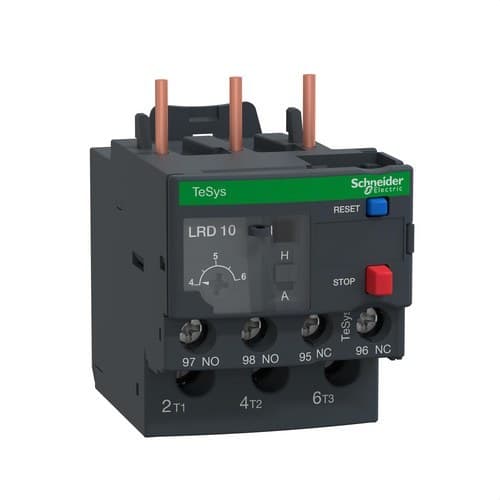
Information about Thermal Relay 4-6A
The Schneider Electric TeSys Deca LRD10 thermal overload relay is a motor protection device with an adjustment range of 4 to 6 A and a 10A trip class. Designed to protect motors against overloads, phase failure, and load imbalance, it includes 1 NO + 1 NC auxiliary contacts, front rotary thermal setting, and test, stop, and reset functions that make commissioning and maintenance of electrical panels easier.
The LRD10 belongs to the Schneider Electric TeSys Deca range and is specifically designed to be directly mounted with compatible TeSys D contactors. In three-phase motor applications, Schneider Electric specifies it for protecting motors up to 2.2 kW at 400 V, provided the motor rated current falls within its 4 to 6 A adjustment range.
Adjustable thermal protection from 4 to 6 A
The Schneider Electric LRD10 allows the thermal protection current to be set between 4 and 6 A. This adjustment makes it possible to match the relay to the rated current of the motor to be protected, providing an appropriate response in sustained overload situations.
The setting is made using a clearly accessible front rotary selector. Once configured, the adjustment mechanism can be protected with a sealable transparent cover to prevent accidental or unauthorized changes.
10A trip class
This thermal overload relay features a 10A trip class in accordance with IEC 60947-4-1. This class is especially suitable for motor applications with normal starting times, providing adequate thermal protection against overloads without causing unnecessary tripping during normal motor starting.
Schneider Electric specifies a trip threshold of 1.14 ± 0.06 times the set current Ir, in accordance with IEC 60947-4-1.
Protection against overload and phase failure
In addition to protecting the motor against prolonged overload, the LRD10 includes sensitivity to phase failure and load imbalance. This protection is especially important in three-phase motors, since loss of one phase can cause increased current in the remaining phases and motor overheating.
For phase-loss detection, Schneider Electric specifies tripping when the current reaches approximately 130% of Ir in two phases while the third remains without current.
Compatible with three-phase motors up to 2.2 kW at 400 V
According to Schneider Electric, the LRD10 thermal overload relay can be used to protect three-phase motors up to 2.2 kW at 400 V, provided the motor rated current is within the adjustable range of 4 to 6 A.
The final relay selection should be made based on the current shown on the motor nameplate and the actual operating conditions of the installation.
1 NO + 1 NC auxiliary contacts
The relay comes standard with two auxiliary contacts, one normally open and one normally closed. These contacts allow the relay status to be integrated into the control circuit to stop the contactor, activate fault indication, or transmit information to control and automation systems.
- Configuration: 1 NO + 1 NC.
- Conventional thermal current of the signaling circuit: 5 A.
- Function: signaling and control after overload trip.
Manual or automatic reset
The Schneider Electric LRD10 includes a selector that allows manual or automatic reset. This feature makes it easy to adapt the relay to the intended operation of each machine or installation.
In manual mode, after the cause of the trip has been removed, intervention on the relay is required before the circuit can be restarted. In applications where it is permitted and appropriate, automatic reset mode can be used.
Stop, reset, and test functions
The front of the LRD10 includes control elements designed to simplify checking and maintenance operations:
- Red stop pushbutton.
- Blue reset pushbutton.
- Manual/automatic reset selector.
- Test function to simulate relay tripping.
- Visual trip indicator.
The test function makes it possible to verify the behavior of the control circuit without having to create a real overload on the motor.
Direct connection to TeSys Deca contactors
The LRD10 thermal overload relay is designed to connect directly to the bottom of Schneider Electric TeSys Deca LC1D09 to LC1D38 three-pole contactors. This arrangement makes it possible to create a compact motor control and protection assembly inside the electrical panel.
Compatible contactors include models from the following families:
- LC1D09.
- LC1D12.
- LC1D18.
- LC1D25.
- LC1D32.
- LC1D38.
It can also be installed separately from the contactor on DIN rail or plate using the specific accessories indicated by Schneider Electric, such as the LAD7B106 terminal block, supplied separately.
Screw terminal connection
The LRD10 reference uses screw terminals, providing a secure connection for conductors in both the power circuit and the auxiliary signaling contacts.
This connection system makes installation in industrial electrical panels easier and allows it to be integrated with contactors and other control and protection components from the TeSys range.
Operating voltage up to 690 V AC
The LRD10 power circuit supports a rated operating voltage of up to 690 V AC and a mains frequency of up to 400 Hz according to IEC 60947-4-1.
- Rated operating voltage: up to 690 V AC.
- Mains frequency: 0 to 400 Hz.
- Rated insulation voltage: 690 V according to IEC 60947-4-1.
- Impulse withstand voltage Uimp: 6 kV.
Temperature compensation
The thermal overload relay incorporates temperature compensation from -20 to 60 °C. This feature helps maintain protection performance within the environmental range specified by the manufacturer, reducing the influence of temperature variations on the thermal mechanism.
Compact design for electrical panels
At only 45 mm wide, the Schneider Electric LRD10 has a compact format suitable for control and automation electrical panels where optimizing available space is important.
- Width: 45 mm.
- Height: 66 mm.
- Depth: 70 mm.
- Net weight: 0.124 kg.
Schneider Electric LRD10 technical characteristics
- Brand: Schneider Electric.
- Range: TeSys Deca.
- Short name: LRD.
- Reference: LRD10.
- Type: differential thermal overload relay.
- Application: motor protection.
- Thermal adjustment range: 4 to 6 A.
- Trip class: 10A.
- Trip class standard: IEC 60947-4-1.
- Indicative three-phase motor at 400 V: up to 2.2 kW.
- Auxiliary contacts: 1 NO + 1 NC.
- Conventional thermal current of the signaling circuit: 5 A.
- Power circuit operating voltage: up to 690 V AC.
- Frequency: 0 to 400 Hz.
- Insulation voltage: 690 V according to IEC 60947-4-1.
- Impulse withstand voltage: 6 kV.
- Trip threshold: 1.14 ± 0.06 Ir.
- Phase-failure sensitivity: yes.
- Load imbalance detection: yes.
- Reset: manual or automatic.
- Test function: yes.
- Stop pushbutton: yes.
- Terminals: screw terminals.
- Temperature compensation: from -20 to 60 °C.
- Dimensions: 45 x 66 x 70 mm.
- Weight: 0.124 kg.
- EAN: 3389110346794.
Reliable protection for motors and automation panels
The Schneider Electric TeSys Deca LRD10 4-6 A is a compact and versatile solution for protecting motors against overloads, phase loss, and current imbalance. Its thermal adjustment, 10A trip class, 1 NO + 1 NC auxiliary contacts, and manual or automatic reset option make it easy to integrate into motor control and protection circuits.
Its direct connection to TeSys Deca LC1D09 to LC1D38 contactors simplifies assembly and allows compact control and protection units to be created, especially suitable for electrical panels, machinery, pumping systems, ventilation, HVAC, and other industrial automation applications.
