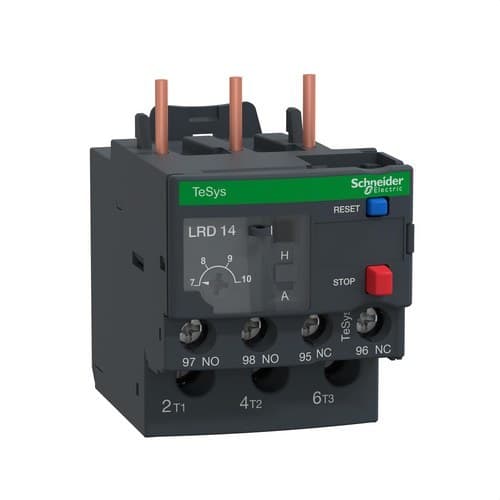
Information about Thermal Relay 7-10A
The Schneider Electric LRD14 is a differential thermal overload relay from the TeSys LRD / TeSys Deca range, designed to protect electric motors against overloads and phase loss. It features a thermal setting range of 7 to 10 A and a trip class 10A according to IEC 60947-4-1, allowing the protection to be adapted to the motor’s rated current. Its design is specifically intended for direct combination with compatible TeSys D contactors to form a compact motor starter.
The LRD14 includes 1 NO + 1 NC auxiliary contacts, stop and reset pushbuttons, and differential sensitivity to phase loss. It can operate in power circuits up to 690 V AC in accordance with IEC 60947-4-1 and offers a compact 45 mm width, suitable for electrical panels for automation, machinery, pumping, ventilation, and other motor control applications.
Key features of the Schneider Electric LRD14
- Differential thermal overload relay for motor protection.
- Brand: Schneider Electric.
- Range: TeSys LRD / TeSys Deca.
- Reference: LRD14.
- Thermal setting range: 7 to 10 A.
- Trip class: 10A according to IEC 60947-4-1.
- Phase-loss sensitive.
- Integrated auxiliary contacts: 1 NO + 1 NC.
- Rated operational voltage of the power circuit: up to 690 V AC.
- Network frequency: 0 to 400 Hz.
- Rated insulation voltage Ui: 690 V according to IEC 60947-4-1.
- Impulse withstand voltage Uimp: 6 kV.
- Red stop pushbutton.
- Blue reset pushbutton.
- Screw terminal connections.
- Direct mounting under compatible TeSys D contactors.
- Possibility of independent mounting on rail or plate using specific accessories.
- IP20 protection rating.
- Dimensions: 45 x 66 x 70 mm.
- Approximate net weight: 0.124 kg.
Adjustable thermal protection from 7 to 10 A
The Schneider LRD14 thermal overload relay allows the protection current to be adjusted within a range of 7 to 10 A. The setting must be made according to the motor’s rated current to be protected, following the motor nameplate data and the installation design criteria.
During operation, the relay monitors the current flowing through the power circuit. If a sustained overload occurs and exceeds the set limits, the thermal mechanism acts on the control circuit to trip the associated contactor, helping prevent excessive motor heating.
Trip class 10A
The Schneider Electric LRD14 belongs to trip class 10A according to IEC 60947-4-1. This classification defines the relay’s time response under overcurrent conditions and is intended for motors with normal starting conditions compatible with a class 10A protection curve.
Schneider Electric specifies a trip threshold of 1.14 ± 0.06 times the set current Ir, in accordance with IEC 60947-4-1.
Phase-loss sensitivity
The LRD14 is a differential thermal overload relay, so in addition to responding to overloads it also provides sensitivity to phase loss or phase imbalance. Schneider Electric specifies tripping at a current of 130% of Ir in two phases while the third phase is at zero current.
This function is especially important in three-phase motors, since loss of one phase can cause a significant current imbalance, overheating, and winding damage if the motor continues to run under those conditions.
1 NO + 1 NC auxiliary contacts
The relay includes as standard one normally open and one normally closed contact for signaling and control circuits. These contacts make it possible to act on the contactor coil and provide auxiliary signals to indicate trip status or integrate the device into automation circuits.
Feature Value Auxiliary contacts 1 NO + 1 NC Conventional thermal current of the signaling circuit 5 A AC-15 permissible current 3 A at 120 V AC DC-13 permissible current 0.22 A at 125 V DCCompatibility with TeSys D contactors
The Schneider LRD14 is designed to be installed directly below different contactors from the TeSys D family, forming a compact motor control and protection assembly.
Schneider Electric indicates direct compatibility with the following contactors:
- LC1D09.
- LC1D12.
- LC1D18.
- LC1D25.
- LC1D32.
- LC1D38.
The combination of the contactor and thermal overload relay allows the contactor to perform switching operations while the LRD14 monitors the motor load conditions.
Direct or independent mounting
The usual mounting of the LRD14 is directly under a compatible TeSys D contactor. This configuration reduces wiring and the space required inside the electrical panel.
When the installation design requires the relay to be placed separately from the contactor, Schneider Electric also provides mounting on rail or plate using specific accessories. This allows adaptation to different panel layouts and control architectures.
Stop and reset pushbuttons
On the front of the relay are the elements needed for basic control and maintenance operations. It features a red stop pushbutton and a blue reset pushbutton, making manual operation easier after checking and resolving the cause of the trip.
Electrical characteristics
Parameter Value Thermal setting range 7 to 10 A Trip class 10A Application Motor protection Type Differential thermal overload relay Network type AC / DC Network frequency 0 to 400 Hz Rated operational voltage Ue 690 V AC, 0 to 400 Hz Rated insulation voltage Ui 690 V according to IEC 60947-4-1 Impulse withstand voltage Uimp 6 kV Trip threshold 1.14 ± 0.06 Ir Auxiliary contacts 1 NO + 1 NC Thermal current of signaling circuit 5 AElectrical connections
The LRD14 uses screw terminals for both the power circuit and the control circuit. The auxiliary circuit accepts conductors from 1 to 2.5 mm², while the power circuit can use different cross-sections depending on the conductor type and termination.
Connection type Permitted cross-section Control circuit, flexible conductor without ferrule 1 to 2.5 mm² Control circuit, flexible conductor with ferrule 1 to 2.5 mm² Control circuit, rigid conductor 1 to 2.5 mm² Power circuit, flexible without ferrule 1.5 to 10 mm² Power circuit, flexible with ferrule 1 to 4 mm² Power circuit, rigid 1 to 6 mm² Tightening torque 1.7 NmDimensions and mechanical characteristics
Feature Value Width 45 mm Height 66 mm Maximum depth 70 mm Net weight 0.124 kg Protection rating IP20Its compact dimensions make it easy to create reduced-size motor starters when combined directly with a compatible TeSys D contactor.
Environmental operating conditions
The relay can operate at ambient temperatures between -20 and +60 °C without derating. For storage, it supports temperatures from -60 to +70 °C.
The device has an IP20 protection rating according to IEC 60529 and is designed to be installed inside panels or electrical enclosures that provide the necessary level of protection for the application environment.
Environmental characteristic Value Operating temperature -20 to +60 °C without derating Storage temperature -60 to +70 °C Protection rating IP20 Vibration resistance 6 Gn according to IEC 60068-2-6 Shock resistance 15 Gn for 11 ms according to IEC 60068-2-7Recommended applications
The Schneider Electric LRD14 7-10 A thermal overload relay is suitable for motors whose rated current falls within its adjustment range. It is ideal for control and automation panels used in many professional and industrial applications.
- Pumps and pressure booster sets.
- Fans and extractors.
- HVAC systems.
- Compressors compatible with class 10A.
- Conveyor belts.
- Industrial machinery.
- Water treatment equipment.
- Motor automation and control systems.
The setting current must be selected according to the motor’s rated characteristics and the actual installation conditions. For correct protection, the contactor, short-circuit protection, and the rest of the starter devices must also be properly coordinated.
Standards and certifications
The Schneider Electric LRD14 complies with the main standards applicable to motor switching, control, and protection devices, including EN/IEC 60947-4-1 and EN/IEC 60947-5-1. The manufacturer’s documentation also lists IEC, UL, CSA, CCC, EAC, BV, RINA, DNV-GL, Lloyd's Register, and ATEX INERIS certifications, among others.
With its adjustable range of 7 to 10 A, class 10A, phase-loss sensitivity, 1 NO + 1 NC auxiliary contacts, and direct compatibility with TeSys D contactors, the Schneider Electric LRD14 is a compact and reliable solution for protecting electric motors against overloads and phase anomalies.
